
Quick Takeaways
- Denials are common but not the end: You have multiple appeal options including reconsideration at OPM and Merit Systems Protection Board appeals. Check out this guide by our Partner Leah Bachmeyer Kille.
- Timeline matters critically: You have only 30 days to file appeals, and missed deadlines can end your case permanently. Here’s a breakdown of what the timeline might look like after denial.
- Agency forms cause most denials: Poor completion of supervisor statements and accommodation forms by unfamiliar HR staff leads to many preventable denials. Check out our video breaking down what supportive documentation looks like.
- Medical documentation requires more than records: You need comprehensive physician statements addressing your specific job duties, not just medical records. Here’s a video detailing what kind of medical support you’ll need.
- Early professional help prevents problems: Getting representation from the beginning creates stronger applications and avoids documentation mistakes that can’t be undone. Read here to learn the real value of hiring an attorney.
Common Questions
Q: How long does the Disability Retirement process take from start to finish?
A: The timeline varies depending on your particular case as well as the current backlog, but in general, 30-90 days to build the application, 1-4 months at your agency, then 8-12 months at OPM for the initial decision. Appeals add 4-8 months per stage.
Q: What’s the most common reason applications get denied?
A: Poorly completed agency forms, especially the supervisor statement (SF 3112B) and accommodation certification (SF 3112D), often filled out by HR staff unfamiliar with your situation.
Q: Can I still apply if I’ve already been separated from federal service?
A: Yes, but it’s much harder. Your date of disability must be before your separation date, and you can’t go back to request accommodation after leaving which can make this much more difficult.
Q: What happens if I miss the 30-day appeal deadline?
A: You lose your right to appeal that denial. If you’re still employed, you can file a new application showing changed circumstances, but separated employees have no options.
Q: Do I need a lawyer for Disability Retirement appeals?
A: While not required, professional representation significantly improves success rates.
Full Webinar Transcript
Leah Bachmeyer Kille (Named Partner 2024) : Today we’re going to be covering reasons for denial. In this presentation. We’ll cover the application timeline, reasons for a denial, medical documentation requirements, reasonable accommodations, what happens if you get denied, and the appeal process as well as understanding all of those appeal options.
Understanding the Application Process
Anna: First, we’re going to take a look at the application process for Disability Retirement.
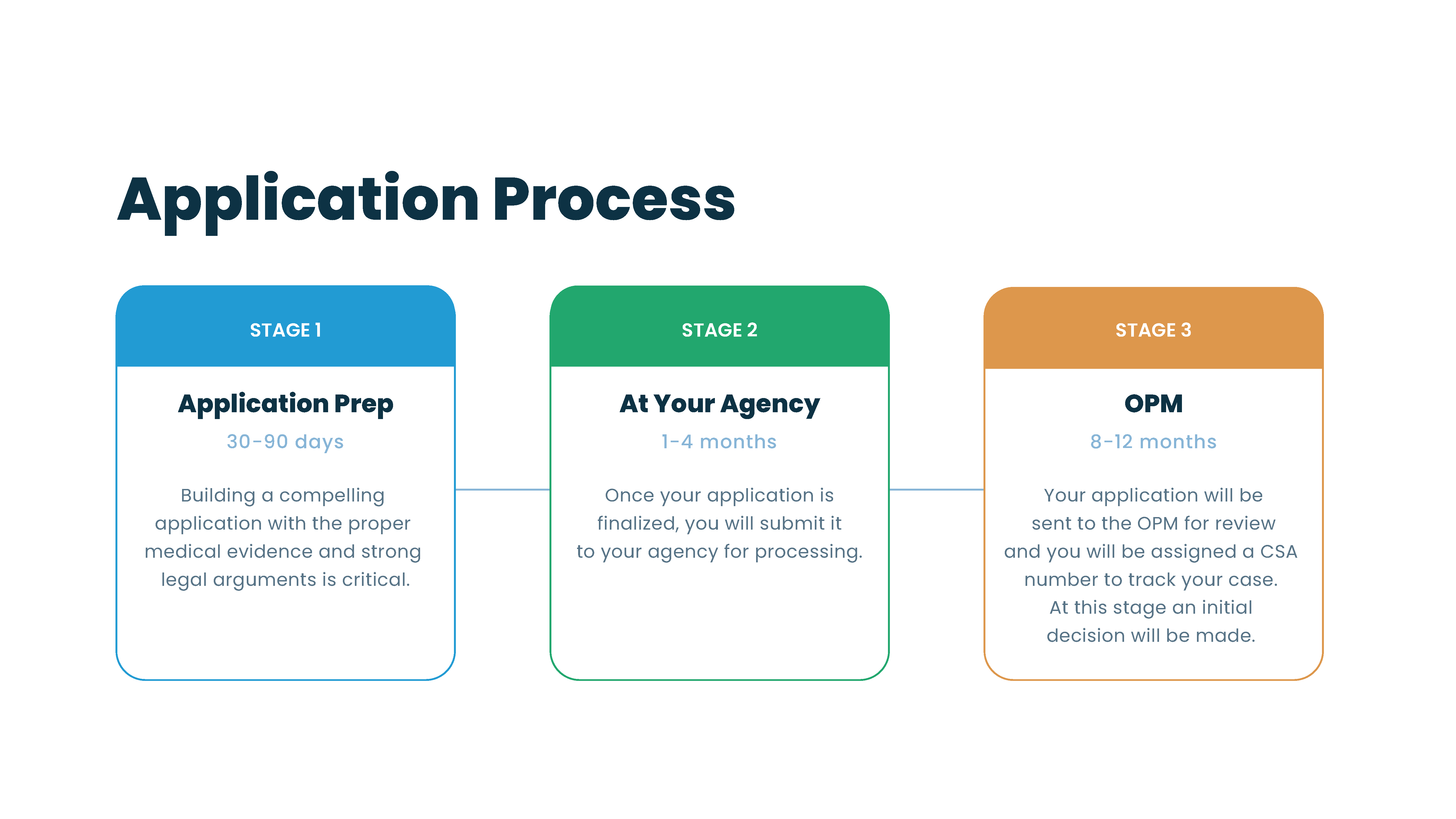
The timeline varies quite a bit depending on the agency that you work for or OPM but generally speaking it takes about 30 to 90 days to build an application that’s going to be approved for Disability Retirement. At that point it’s going to be submitted to your agency if you’re still on the rolls, and depending on the agency again it can take anywhere between one and four months before your application gets to the OPM.
OPM’s decisions can vary greatly but lately we’ve been seeing anywhere between 8 and 12 months.
Leah: Like Anna said, the application time can vary. Keep in mind the application prep is all dependent upon the documents that you might need to gather like application forms as well as medical documentation or perhaps some prep work for documents at your agency that need to be completed before submitting an application.
At the agency, like Anna said, one to four months – the guidelines published by OPM really recommend that an agency does things within 30 days, but that’s quite unrealistic for federal agencies considering the work that needs to be done. A very good agency can do it in 30 days, but I think for the most part anywhere between one to four months is still very typical.
Anna: What happens if you go through this whole process and the medical specialist at OPM denies your claim?
Leah: That medical specialist is going to write an initial decision letter. They’re going to date it, have your CSA number, and you’ll get it by certified mail typically. They can vary in length – some are like four pages, others I’ve seen get up to 20 pages – but it’s going to outline the requirements for Disability Retirement and then go through your particular application and give reasons for a denial.
Understanding Common Reasons for a Denial
Anna: Let’s look at some of the more common reasons for denials that we see typically.
The first one that we see a lot of is issues with various forms. We’re going to talk about the SF 3112A first – this is the applicant statement of disability form.
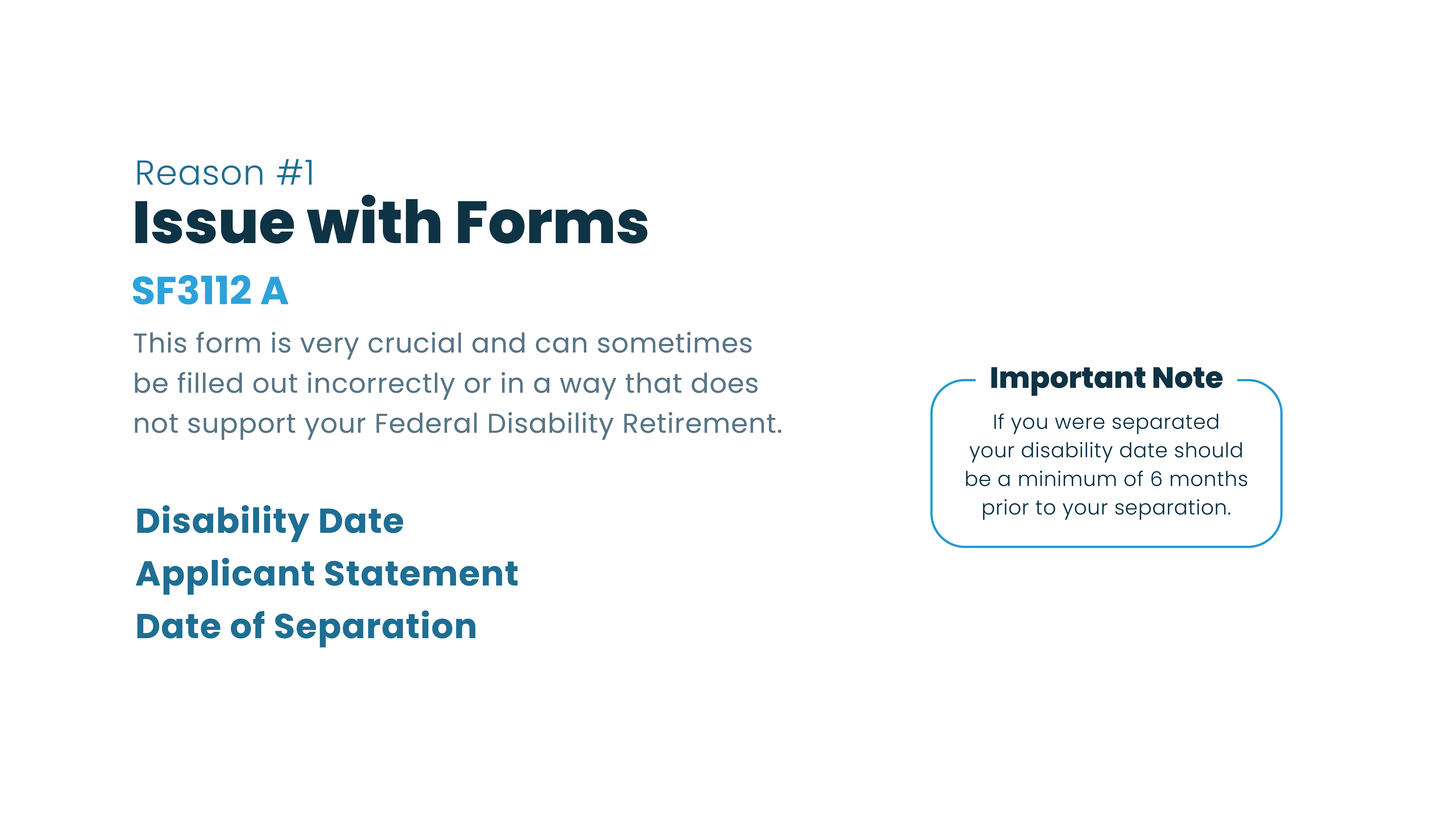
Leah: The 3112A kind of lays out your statement of disability – what your medical conditions are, how they interfere with your ability to engage in your particular federal position’s essential job duties, as well as how it affects you at home. You also need to list a date of disability, if you’ve been accommodated or not by your agency.
It’s a two-page form but typically speaking you may need to add a third page just because the spaces underneath the areas to fill out can be a little short. If you really want to get into your diagnosis and the reasons you’re disabled, a lot of times we recommend having a longer statement than just the form itself.
This form is extremely crucial and there’s lots of things on it that can go wrong. For example, maybe you don’t list all of your diagnosed conditions. It can be very hard or impossible to add conditions later on depending on what stage of appeal you’re at.
Another common one is the disability date. You are supposed to approximate the date you became disabled. An important note to that is if you were separated, be sure that your disability date is before your separation, otherwise you’re alleging you didn’t become disabled until after you left your job, which will not let you qualify for Disability Retirement.
We typically recommend separated employees pick a date at least several months before their separation just so that they can establish the timeline of realizing they had a diagnosis, having difficulties at work, and then being separated either by the agency or through resignation.
Medical Documentation Requirements
Anna: Another part of the 3112 as a whole is going to be the 3112C which covers your medical documentation. The form itself is a little misleading because you just sign it, you put an address on there, and it does outline what’s expected for medical documentation, but it’s not super clear. So, we do see a lot of issues with OPM denying claims based on a lack of objective medical evidence or doctor support.
Leah: The form itself you just sign and submit, and a lot of people think “Oh, OPM will get me my medical documentation similar to Social Security” – that is not the case. You are supposed to submit medical documentation, and even the form itself I don’t think quite says what OPM is looking for because it asks for physician statement. So maybe a letter from your doctor addressing the things listed on the 3112C, but in reality OPM expects you to submit medical records plus comprehensive medical statements.
You’re not usually going to get away with just a medical statement. It’s going to have to include more and it’s going to show that you have a diagnosed medical condition that’s interfering with some of your ability to work. This may be stated explicitly or maybe it’s kind of unwritten, but it talks about the difficulties you have.
You also need to have a prognosis of a medical condition lasting at least 12 months from the date of your application – so that’s not the date you were diagnosed, that’s the date that you submitted your application.
There are a lot of little things that can go wrong as far as wording and medical documentation that can lead to a denial that will need to be corrected in the appeal phase.
Anna: Beyond just the medical records, we talked a little bit about a statement from your doctor, and OPM is really specific in the types of things they want to see in one of those statements or narratives.
Leah: Ideally, OPM is looking for records as well as a separate letter from your doctor, ideally on physician letterhead, although I’ve seen them successfully take and approve people if your attorney like our firm does some things on our letterhead, but it would need a signature from the doctor and need to kind of line up with the medical records that are provided.
It really needs to get into your diagnoses, your prognosis, as well as describe what you’ve been doing as far as treatment goes. Disability Retirement does require that you are compliant with reasonably prescribed medical treatment. So there needs to be information about what treatment is available, what treatment you’ve been doing, and confirming that you’ve been compliant. That includes not having gaps in your treatment – taking your medication, going to therapy and doctors’ appointments.
Agency Accommodation Requirements
Anna: Aside from medical documentation and doctor support, there are some other pieces of the 3112 that your agency has to be engaged in, most specifically the 3112D which is the agency certification of reassignment and accommodation efforts.
OPM has really specific requirements about what you have done as far as reasonable accommodation requests go and what your agency has done.
Leah: Typically speaking that form does need to be filled out and it’s a very generic form. It permits agencies to kind of just click boxes on whether or not you’ve gone through accommodation and the results of that, to also include the accommodation of last resort which is reassignment.
We see a lot of times that those forms can be completed very badly where it says “no accommodation requests received” and “reassignments not necessary, employees performing job duties,” and it can be very frustrating to people. A lot of times that form can be filled out inaccurately. A lot of HR specialists that aren’t necessarily even at your local agency end up filling out this form, and they’re just looking in your personnel file for accommodation requests that were formal.
It doesn’t necessarily address if you’ve done informal accommodation requests or maybe you just talked with your supervisor, and he told you “yeah we can’t accommodate you.”
Preparing for that form is really a good idea. If you hadn’t prepared for that form or maybe you did prepare and it just got filled out badly, throughout the appeal process you can hopefully get some updates to overcome that.
Key Point: Keep in mind if you have been separated, that doesn’t alleviate the need for this form. The OPM will still request this form from your past employing agency. So if you have been separated, it’s a good idea to go ahead and start thinking about gathering documentation maybe showing a history of your reasonable accommodation requests prior to your separation.
We see a lot with separated employees that a lot of errors can occur with the completion of that 3112D simply because maybe they don’t remember you that well and they’re just going on your personnel file if they still have it, since personnel files can often be forwarded to the National Personnel Records Center after a certain amount of time.
Agency Unfamiliarity with the Process
Anna: That kind of leads into our next reason which is just general agency unfamiliarity with the Disability Retirement process and what OPM’s rules are, and expectations are regarding an approval for the benefit.

Leah: We see a lot of times with denials – people that hire us at the denial level especially – they weren’t necessarily disclosing a lot of things to their agency. Maybe they wanted to keep things private and didn’t feel that the agency should know about things.
Unfortunately, because of the B and D forms being required on the 3112, it’s really actually a much better idea to be transparent with your agency and try to get them familiar with the process of Disability Retirement. Simply because if your agency doesn’t know about your conditions, they can really hurt you in filling out the forms incorrectly.
For example, if the person who fills out your supervisor statement – you haven’t disclosed that you’ve been struggling due to a medical condition – they may fill out that form very unsupportively and that can impact your Disability Retirement. It’s a lot easier to receive forms filled out correctly when you’ve discussed your medical conditions with the person that’s going to be filling out the supervisor statement, if you’ve gone through maybe a more formal accommodation process so that HR has that request on record.
These are required forms. So, if your supervisor is saying “hey I don’t have to fill out that form,” maybe they’re just unfamiliar with the Disability Retirement process. These forms are required by OPM. You need to submit them with your application. If they don’t get submitted with it, OPM will request them. If OPM is unsuccessful in getting them, then a judge at the board level is still going to want them. So, you can’t get around the absence of forms.
Anna: It’s important to note too that some people are really anxious to discuss this with their agency, but your agency will have to participate in this process along the way. So, the sooner you can start discussing it with them, the easier this process will be for you.
One really important point regarding the SF3112 D is the agency’s understanding of what an accommodation is versus what OPM is looking for as far as accommodations go.
Leah: Under the ADA, an accommodation is something that allows you to perform your job with or without accommodations. If you’ve got a medical condition, an accommodation specifically has to permit you to perform the essential functions of your position.
Giving you light duty assignments, taking away certain aspects of your job that are essential to your job, or reassigning you informally – none of those are going to be a true accommodation for Disability Retirement purposes. The law on this is really clear under a famous case called Bracey versus OPM that we end up having to cite to a lot.
Going through the accommodation process is really important because it allows us to build the case that you’ve requested accommodation, maybe you’ve been denied, and we need to flesh out the reasons for that denial and how you don’t meet the requirements for an accommodation under the ADA.
This is important to go through the accommodation process prior to separation. Once you’ve been separated, you can’t really go back and ask for accommodation when you’ve been separated for three months. Your agency is not going to remember you sometimes, and they’re certainly not going to want to fill out paperwork contemplating what accommodation would have been possible prior to your separation.
Anna: That’s exactly right Leah. I know we’ve run into that a handful of times, and it just makes it significantly more difficult to prove that your agency could not accommodate you.
Leah: Harder but not impossible. So even if you’ve gotten bad agency forms in a denial, keep in mind there are ways to overcome those issues.
What if You Are Denied?
Anna: So that kind of goes through the reasons for denial, but what about actually taking action if you are denied?
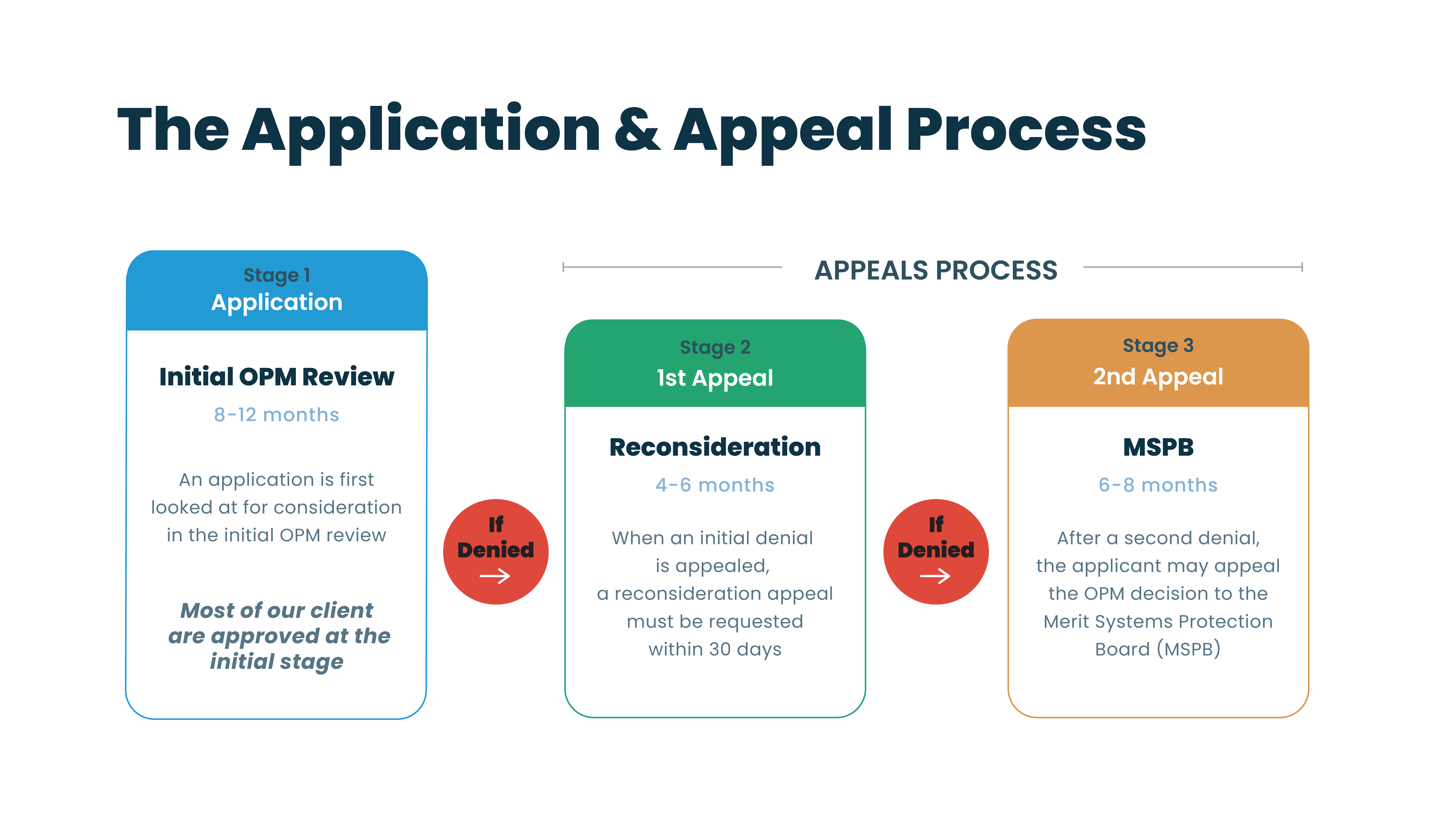
If you are denied, you’ve got appeal rights. If you go through an initial denial, you’re going to have a first appeal right as well as a second appeal right, and actually further appeal rights past that, but we’re really just going to focus on the next two appeal stages.
The first appeal is called reconsideration – it takes an average of about 4 to 6 months to go through. Again that’s an average – some cases take a bit longer, some cases are a bit shorter.
The second stage is called the Merit Systems Protection Board initial appeal, and on average it can take about 6 to 8 months. Again, some cases a bit shorter than that, some cases a bit longer than that.
Anna: When you are applying for Disability Retirement, you’re going to start with your initial application and OPM will review that. A medical specialist is going to make that decision.
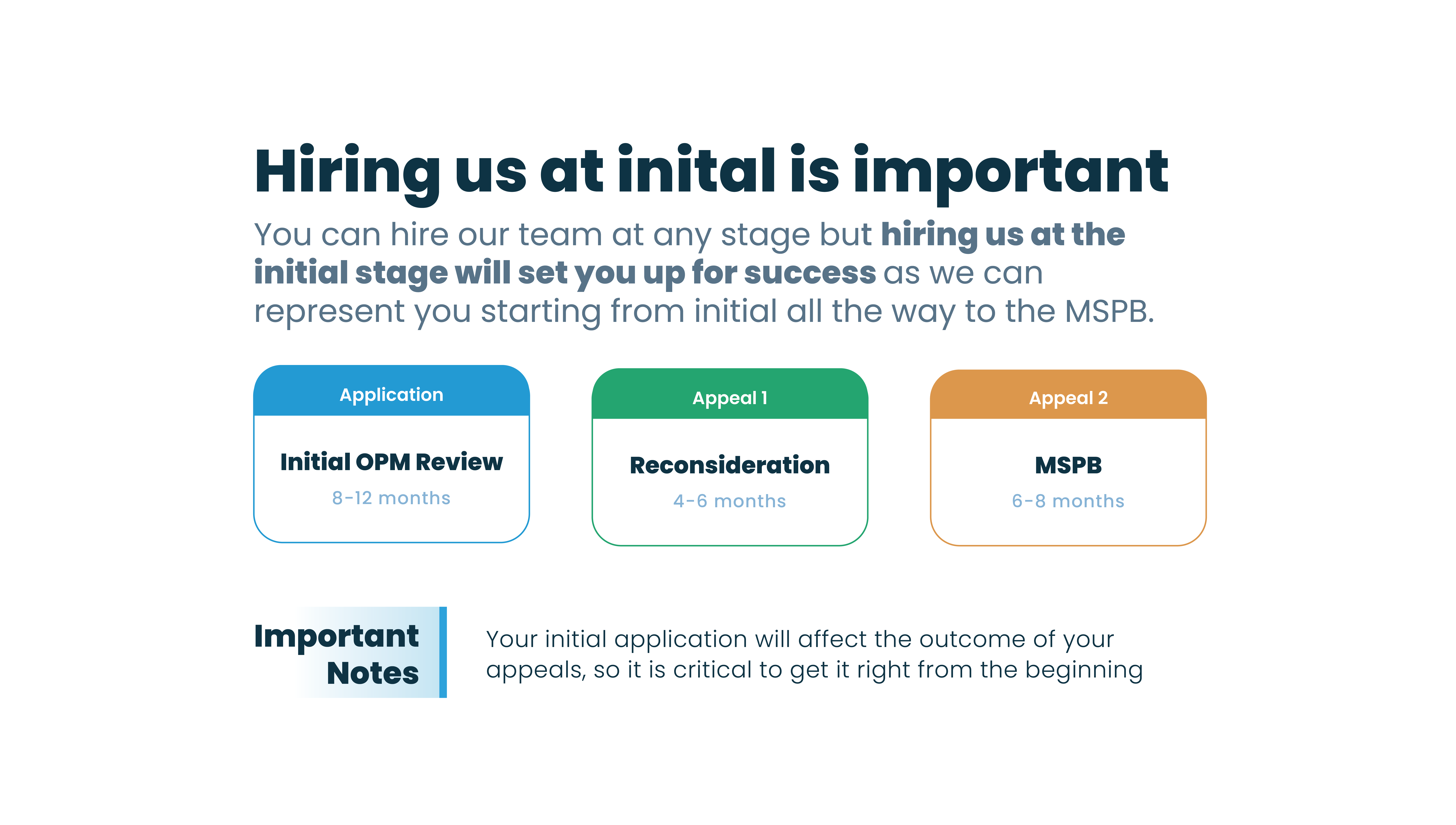
Most of our clients are approved at the initial stage, but if you are denied you can go to the next level which is the reconsideration level. This still takes place at OPM. Your claim will be assigned a new medical specialist, and you’ll have an additional 30 days to submit an appeal.
You can request additional time to send in further supporting documentation, or if you feel that OPM made a mistake, you can have them reissue a decision based on what they have. It’s generally in your best interest to not do that – you should usually submit additional documentation if you have been denied.
Once you go through the reconsideration process and submit your appeal, OPM could at this point deny you again, at which point you will have rights to an MSPB appeal. This takes place outside of OPM – this is not within the OPM anymore.
Merit Systems Protection Board Appeals
Leah: The Merit Systems Protection Board is a quasi-judicial administrative agency. It was created to protect the merit principles of federal employment. They hear a hodgepodge of cases, but one of their original jurisdiction cases is retirement cases – any retirement case. So Disability Retirement also falls under that.
The Merit Systems Protection Board has a number of regional offices throughout the United States. You can Google “MSPB regional offices.” You file to whichever one is closest to your physical location, but you’re never actually going to travel there. Things done at the MSPB are now electronic as well as telephonic or Zoom conferences and have been actually prior to the pandemic.
You do need to file the Merit Systems Protection Board appeal within 30 days of your receipt of the denial letter. Ideally you actually want to file within 30 days of the date of the denial letter just because proving that you received it a little later on from that with a postmark date can be a bit cumbersome, so it’s better to just be safe rather than sorry.
When you file your appeal, it goes to that regional office and the MSPB will assign an administrative law judge to your case who will ultimately hear your case in a telephonic or video conference hearing. But it’s not just you participating – you can have medical providers or family and friends or co-workers or supervisors participate in the hearing.
The OPM also participates. They have legal specialists out of an appeal office in Washington DC that participate in these hearings and in these appeals and represent the OPM’s decision, which can also be changed during this time period by the legal specialist.
Keep in mind if you lost at MSPB, or maybe you didn’t appeal in time, you still have the ability to reapply after these denials as long as you are still employed by the federal agency. You will need to show a change in circumstance. This can be the worsening of a medical condition, something changed at your work, maybe an accommodation was taken away, or maybe a medical condition has newly arisen. Something has changed, but keep in mind you can still reapply as long as you’re still federally employed.
Now if you were separated, your one application is all you’ve got to go on.
Further Appeal Options
Anna: If you’re denied at MSPB, aside from starting all over from the beginning if you’ve had a change in circumstance, I know there are a couple of further appeal options that exist.
Leah: You can submit what’s called a petition for review to the full board in Washington DC. It is extremely backlogged, so we don’t have a specific time frame. They didn’t have a full quorum of judges, so realistically it’s probably going to take a number of years for them to work through the backlog and get to your case.
The panel is three judges that would review the written file. They only reverse if you meet certain criteria within a petition for review. It’s not like you get to tell your story all over again – you really need to prove that something went wrong with the judge’s initial decision. Maybe they were basing their decision on an incorrect material fact or something like that.
You can also request to have your case taken to the U.S. Court of Appeals for the Federal Circuit to make a decision on your case. That specific court is very strict as far as filings – when to file things, how they need to look. Be aware that it’s significantly stricter than the Merit Systems Protection Board, which is an administrative agency at its heart and is much more lenient on filings. The federal circuit is a lot harder on folks.
Most of the time we don’t recommend going through that appeals process if at all possible. If you can make a new application, that’s a much better option.
The Importance of Professional Help
Anna: That is some great information Leah, and you know it sounds like this can be a complicated process, which is why it’s really important to get some professional guidance from the very beginning. If you start off with a really strong application, then your chances at the initial level and the following appeals is much higher. So, we really recommend getting some assistance as early on in the process as possible.
Leah: That’s absolutely correct. It’s really heartbreaking to get phone calls from folks that maybe have gotten an initial denial and maybe didn’t do the best job with agency documentation or maybe with medical documentation. It makes the appeal process a lot harder and can be extra stressful because you’ve already got this bad documentation on file.
Typically speaking, when you have help from the initial stage, it’s a lot easier to control the documentation. So if something does go wrong like in an agency form, your representative can be prepared and see in the file what can already be used to overcome it.
Anna: I’d also like to point out that once something has been submitted for your Disability Retirement application, it cannot be unsubmitted. So, anything that gets submitted at the initial level by yourself or somebody assisting you with that process is in your application for the duration of the process. So, nothing can be taken back if it was submitted erroneously.
Leah: That’s correct, and keep in mind that’s true even if you do a new application. OPM would still have your original application, and if it’s done close in time especially, they’re going to be really looking at it to see why you did a new application.
Anna: So, with all that being said, Harris Federal is here specifically to help federal employees through this process. It’s a maze of forms and rules and requirements, but we have years and years of experience handling these types of claims. Leah specifically has been handling these Disability Retirement claims for almost 10 years now. (Update 9/4/25: almost 12 years)
Don’t risk it alone – we’re here to help you with it.
Leah: We have a 99% success rate. A lot of times we’re able to give a 100% money back promise, and we have over 6,000 happy clients (Update 9/4/25: We’ve assisted over 10,000 federal workers). You can read some of our Google reviews or Facebook reviews or look around on our website for client testimonials. We really pride ourselves in helping people when they need to retire due to a disability.
Key Recap Points
Anna: Just to kind of recap what we’ve gone over:
- The application process for Disability Retirement can be lengthy
- It is really important to make sure you get all of the required documents together
- Deadlines are critical – OPM does not look kindly on missed deadlines
- If you are denied, you do have appeal options
- Most importantly, we’re here to help you through this process
Leah: That’s absolutely right, and we’re still here to actually answer your questions. Feel free to get into our chat and send us some questions. Hopefully we can give you some answers or potentially set you up for a free phone consultation.