
Quick Takeaways
- A service deficiency is required: You must demonstrate a deficiency in performance, attendance, or conduct to qualify for Federal Disability Retirement — your medical condition must be impacting your job.
- Attendance deficiencies are the most common: Excessive use of sick leave, annual leave, FMLA, or LWOP already signals an attendance deficiency — you don’t need to take consecutive time off.
- Conduct deficiencies are the hardest to prove: Because conduct issues are typically tied to mental health conditions, strong physician documentation is especially critical for this type of deficiency.
- Multiple deficiencies strengthen your case: You can have more than one type of service deficiency at the same time, and documenting all of them works in your favor.
- Federal Disability Retirement is a bridge to age 62: You receive 60% of your high-three salary in year one and 40% every year after until age 62, while continuing to earn creditable service toward regular retirement.
Common Questions
Q: What is a service deficiency, and why does it matter for Federal Disability Retirement?
A: A service deficiency is the inability to perform at least one major function of your current position, resulting in documented problems with performance, attendance, or conduct. OPM [Office of Personnel Management] requires this as one of the core qualification requirements — it’s how you demonstrate that your medical condition is actively affecting your job.
Q: What counts as an attendance deficiency?
A: Excessive use of leave — including exhausted sick or annual leave, FMLA, or LWOP (Leave Without Pay) — qualifies as an attendance deficiency. You don’t need to take consecutive time off; intermittent absences caused by your medical condition count too.
Q: What documentation can I use to prove a service deficiency?
A: Useful documentation includes leave and earnings statements, leave reports, poor performance evaluations, work restrictions from a medical provider, supervisor statements, and light duty job assignments. Any agency or medical records that confirm a deficiency will help strengthen your application.
Q: Can I have more than one type of service deficiency?
A: Yes — you can have performance, attendance, and conduct deficiencies simultaneously. Having multiple documented deficiencies actually strengthens your Federal Disability Retirement case.
Q: What if I don’t have a service deficiency?
A: If no deficiency is documented, you must show that your medical condition is incompatible with other useful service or retention in your current position. Regardless, documenting any deficiencies you do have is always recommended to build the strongest possible case.
Full Webinar Transcript
Understanding Federal Disability Retirement
Kimberly Courtney (Director of Case Processing): Federal Disability Retirement is an early retirement option for federal employees who are struggling with their job due to a medical condition. Specifically, this benefit is provided by the OPM [Office of Personnel Management] and it does last until your regular retirement at age 62.
Hannah Spahn (Client Experience Specialist): Exactly. We often refer to this benefit as a bridge to 62, because the benefits that Federal Disability Retirement provides allows you to make it to your full retirement age.
Now, Federal Disability Retirement provides four main benefits: a monthly annuity payment, creditable years of service, the ability to work in the private sector, and then the option to maintain your health and life insurance.
Annuity Payments and the High-Three Salary
Kimberly: Your annuity payments while on Federal Disability Retirement — for your first year you’re going to receive 60% of your high-three salary, and every year after that until the age of 62 you’re going to be receiving 40% of your high-three salary. It’s important to know that your high-three salary is just the highest 36 consecutive months of basic pay. Your Disability Retirement payments are going to be taxable income, and you do have the ability to keep your benefits into retirement such as health and life insurance.
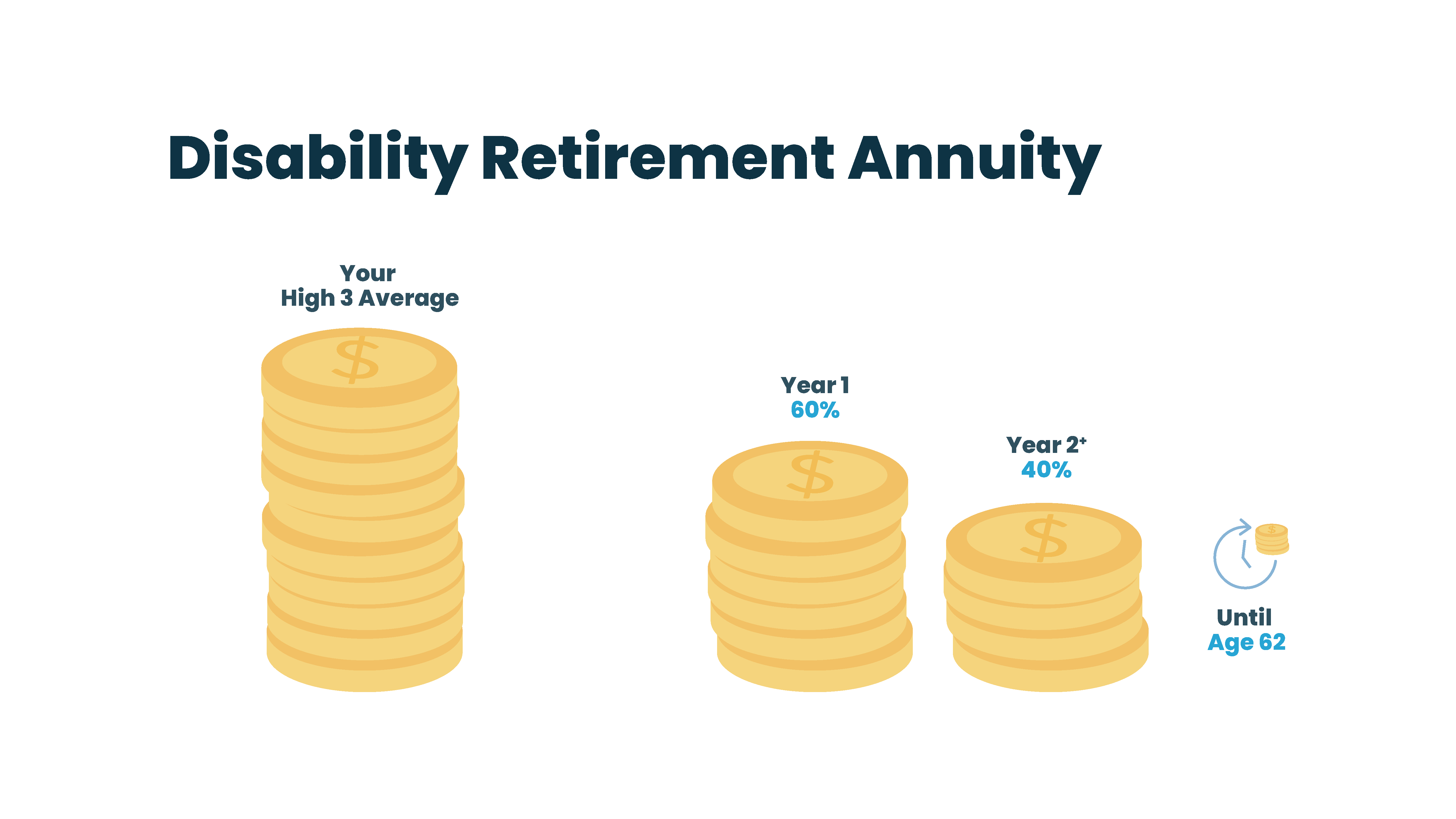
Hannah: Exactly. Now let’s look at a visual representation here of what your Disability Retirement annuity is going to look like. If you look at the large stack of coins there on the left, that represents your full high-three average, and then you’ll see year one and year two is going to be a portion of that high-three average — and you’re going to be receiving that 40% of your high-three average until you turn age 62.
Kimberly: Additionally, while you’re receiving the Federal Disability Retirement, you get to continue earning years of creditable service towards your regular retirement. So, every year that you’re on the Disability Retirement is going to count towards your regular retirement as if you were working for the federal government during that time.
Hannah: Yeah, so that’s a super important benefit of Federal Disability Retirement that you want to keep in mind as you’re looking towards your future in retirement.
Working in the Private Sector
Hannah: Now you’re also going to be able to work in the private sector and earn additional income on top of your annuity. An approved Federal Disability Retirement application only proves you have an occupational disability, not necessarily a total disability. So, you’ve still got that option to find a different job in the private sector. We see a lot of our clients go on to pursue other types of employment — a lot of delivery drivers, we’ve seen a lot of teachers, realtors, even lawyers. And when you’re working in the private sector, you’ve got the option to earn up to 80% of your old position’s current income.
Kimberly: That’s exactly right. I’ve had a lot of my personal clients go on to be realtors, teachers, anything within their medical restrictions in the private sector — and as Hannah stated, that does not affect your annuity payment while on Federal Disability Retirement.
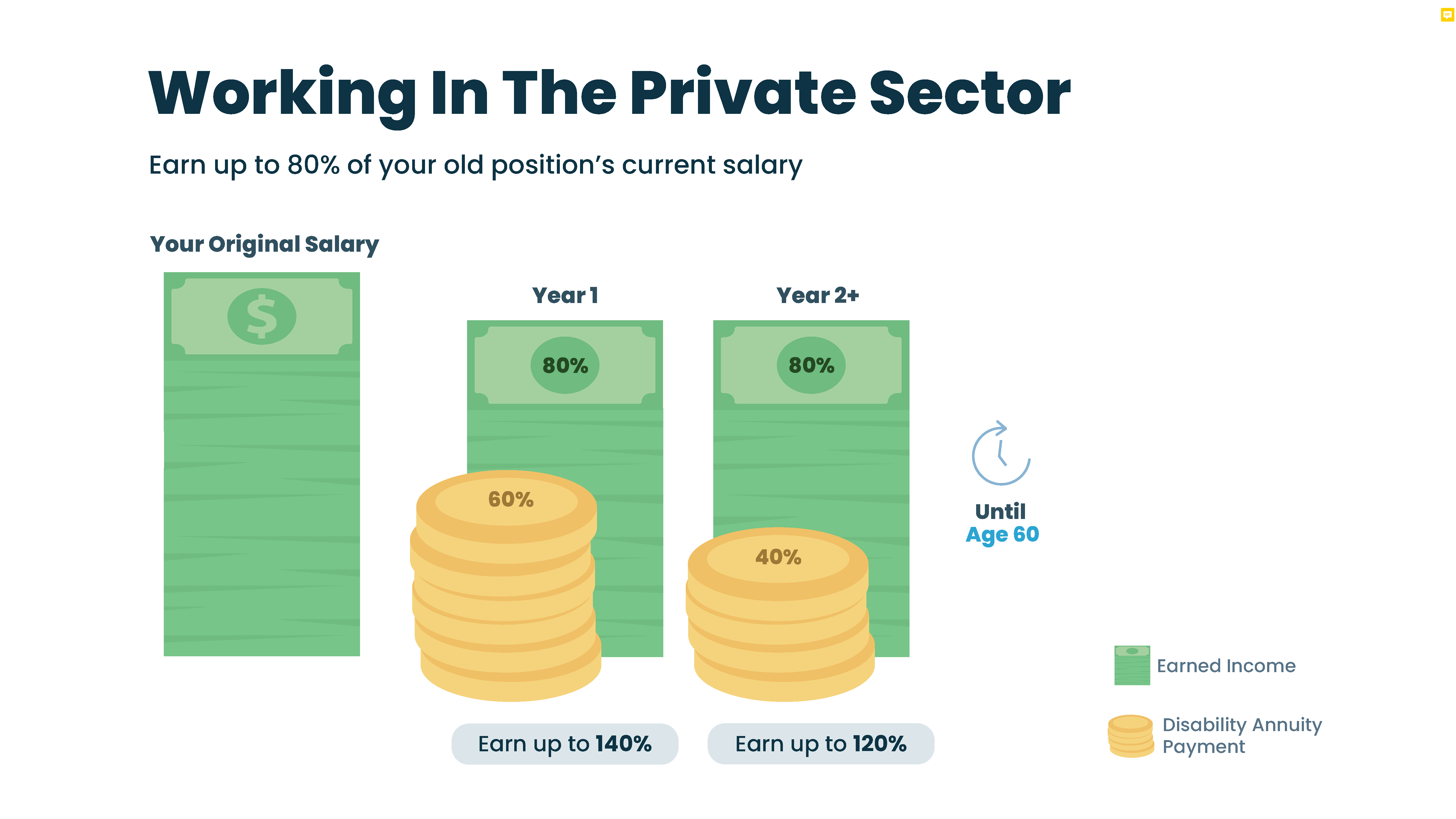
Hannah: Now looking at this visual representation, you can see how your earnings in the private sector can add to your Disability Retirement annuity payments. If you look at the stack of money over on the left, that represents your original salary, and then the smaller stacks represent 80% of your original salary, which is what you can make working in the private sector while on Federal Disability Retirement.
Kimberly: One thing you should know is that the 80% earning cap is only in place until you reach age 60. After age 60, there is no earning cap set forth by OPM, so you can make as much as you want without affecting your Disability Retirement payments.
Hannah: Exactly. So you can see here how working in the private sector along with your Disability Retirement annuity payments allows you to earn more than what you were previously making in your federal job alone.
Kimberly: One perk once you’re approved for Federal Disability Retirement is that you get to maintain your health and life insurance. These benefits will carry over through the rest of your retirement into your regular retirement as well.
Eligibility and Qualification Requirements
Hannah: Perfect. So at this point you may be wondering if you are eligible. In order to be eligible for Federal Disability Retirement, you must meet three eligibility requirements.
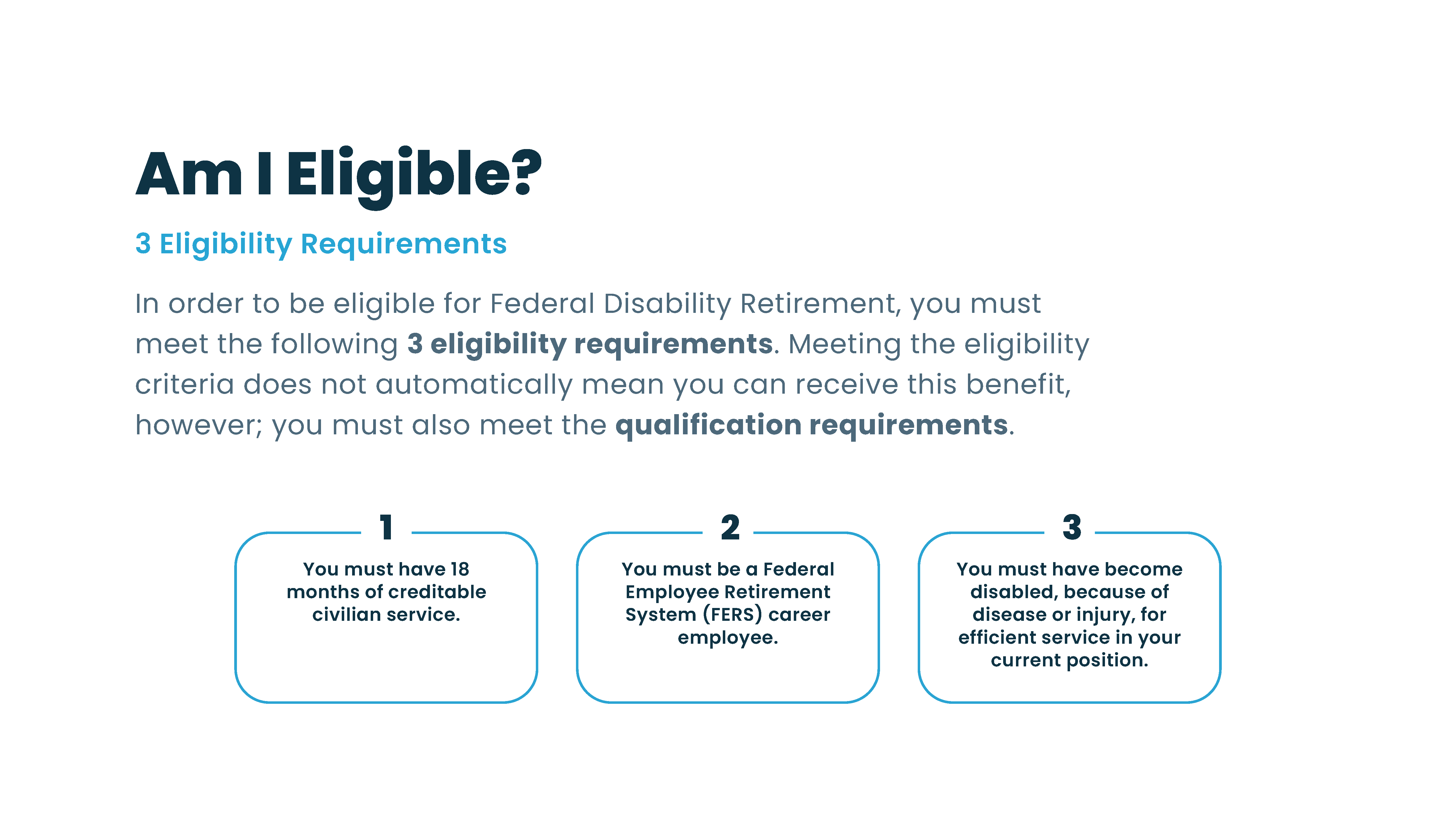
Your three eligibility requirements are:
-
- You must have 18 months of creditable civilian service
- You must be a Federal Employee Retirement System [FERS] career employee
- You must have become disabled because of disease or injury affecting efficient service in your current position
Hannah: Meeting these requirements does not automatically mean you’re going to be able to receive the benefit, because you also must meet qualification requirements.
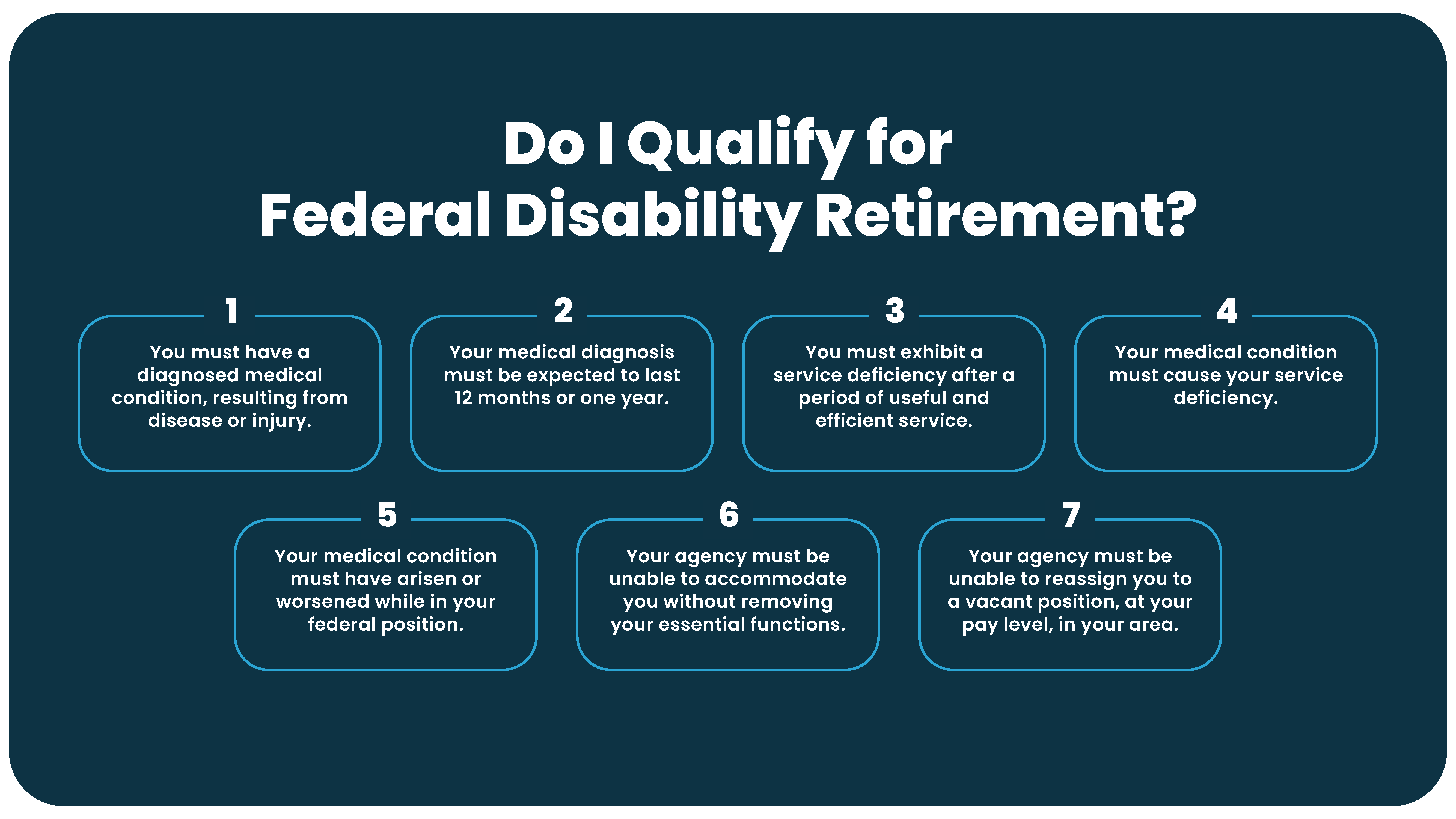
The seven qualification requirements are:
-
- You must have a diagnosed medical condition
- It must be expected to last for at least one year
- You must exhibit a service deficiency — which is what we’re going to be talking about a little bit later in this webinar
- Your medical condition must cause your service deficiency
- Your medical condition must have arisen or worsened while in your federal position
- Your agency must be unable to accommodate you without removing essential functions
- You agency must be unable to reassign you
Kimberly: We’ve had a lot of clients with different medical conditions that have qualified for Federal Disability Retirement, such as bipolar disorder, post-traumatic stress disorder, physical conditions such as lumbar strain, ligament tears, things like that.
The Three Types of Service Deficiencies
Kimberly: Next, we’ll discuss what service deficiencies qualify you for Federal Disability Retirement.
Hannah: As I mentioned earlier, having a service deficiency is one of the qualification requirements for Federal Disability Retirement. A service deficiency is the inability to perform at least one major function of your current job that leads to a deficiency in performance, attendance, or conduct. This basically just means that your medical condition must be impacting your job in a negative way.
Performance Deficiencies
Kimberly: A performance deficiency is a decrease in your performance at work. There are many ways that this can be shown — this could be poor performance evaluations, reduced work output, adjusted work performance plans. If you’re still performing satisfactory work, you must show that your medical condition is incompatible with continued performance.
It can sometimes be difficult to talk to your supervisor about how your medical conditions are affecting your performance at work, but it is important. We do want that documented with your agency or your supervisor, just to add that additional support and strength to your Federal Disability Retirement claim.
Attendance Deficiencies
Hannah: Attendance deficiencies are some of the most common service deficiencies that we see. An attendance deficiency is simply an excessive use of leave. So if you’ve run out of sick or annual leave, if you’re utilizing FMLA or LWOP [Leave Without Pay], it’s likely that you already have what is considered to be an attendance deficiency.
Kimberly: One thing to note is you don’t have to take consecutive time off or be in a full leave status to have an attendance deficiency. By taking multiple days and times off of work because of your medical conditions, that adds to that attendance deficiency.
Conduct Deficiencies
Hannah: The last deficiency that could be documented for your Disability Retirement application is the conduct deficiency. This means that your conduct at work is impacting your ability to perform your job. This is typically going to be associated with mental health conditions. This is a pretty hard deficiency to prove that it is related to your medical conditions, so you will want a supportive doctor for any conduct deficiency that you currently have documented.
Key Point: Conduct deficiencies are most commonly tied to mental health conditions such as PTSD or bipolar disorder. Because they can be difficult to connect directly to a medical condition, having a physician who will clearly document that connection in writing is especially important.
Documenting Your Service Deficiency
Hannah: Now, if you don’t have a service deficiency, you must show that your medical condition is incompatible with other useful service or retention in your current position. Regardless, it’s important to document any service deficiencies that you may have in order to strengthen your case as much as possible.
Kimberly: There are a lot of different types of documentation that can be used to prove these service deficiencies. Some of them include:
-
- Excessive use of leave — this could be shown with a leave and earnings statement or a leave report
- Poor performance evaluations
- Work restrictions from a medical provider
- Supervisor statements
- Light duty job assignments
- Any documentation from your agency or medical provider agreeing to one of these listed deficiencies
Hannah: Exactly. And these supervisor reports and medical documentations are really important to showcase these service deficiencies — and that’s a really big aspect of your application for Federal Disability Retirement.
Closing Summary
Kimberly: Now we’ve covered a lot of information in this webinar, but it’s really important to note that some type of deficiency is required in your Federal Disability Retirement application — whether it’s performance, attendance, or conduct. You can have multiple deficiencies, and having more than just one does strengthen your case. So that is completely okay.
Key Point: You are not limited to one type of service deficiency. Documenting performance, attendance, and conduct issues together gives OPM a more complete picture of how your medical condition is affecting your federal service — and makes for a stronger application overall.
If you want to find out if you have a service deficiency, we can discuss this over the phone in a free, 1-on-1 consultation.