
Quick Takeaways
- Light duty is not reasonable accommodation: For Disability Retirement purposes, any accommodation that removes essential job duties doesn’t qualify as a valid reasonable accommodation.
- Accommodation must enable full job performance: A true reasonable accommodation allows you to continue performing every single essential duty of your position, not just some of them.
- Reassignment has strict requirements: Valid reassignment offers must be existing vacant positions at your same pay and grade, within your commuting area, within your medical restrictions, and which you’re qualified to perform.
- This requirement can make or break your claim: The reasonable accommodation and reassignment process is a critical requirement that can have the biggest impact on your Disability Retirement application.
- Every agency has different procedures: Each federal agency has its own specific processes, timelines, and forms for reasonable accommodation requests and reassignment.
Common Questions
Q: What’s the difference between the ADA definition and OPM’s definition of reasonable accommodation?
A: The ADA allows light or modified duties as accommodation, but OPM does not. For Federal Disability Retirement, an accommodation must allow you to perform all essential duties of your position.
Q: When should I request reasonable accommodation?
A: Request accommodation as soon as you’re having trouble performing your job or when your doctor places you under restrictions. If you’re applying for Disability Retirement, you must submit a reasonable accommodation request with your application.
Q: What is reassignment and how does it differ from reasonable accommodation?
A: Reassignment is a separate requirement where your agency must attempt to place you in a different position. It must be an existing vacant position at your same pay and grade, within your commuting area and medical restrictions, and which you’re qualified to perform.
Q: Can a letter carrier whose lifting restriction is reduced to 40 pounds be considered accommodated?
A: No. If the position requires lifting 70 pounds at any given time, reducing that to 40 pounds removes an essential duty and therefore doesn’t qualify as accommodation for Disability Retirement purposes.
Q: Do I have to accept every reassignment offer from my agency?
A: No. You only have to accept reassignment offers that meet all the required criteria: existing vacant position, same pay and grade, within commuting area, within medical restrictions, and which you’re qualified to perform.
Full Webinar Transcript
Ashley Withers (Senior Federal Disability Case Manager): Welcome to today’s webinar. We’re going to be talking about reasonable accommodation and how that can play into a Disability Retirement. My name is Ashley Withers, I’m a Senior Federal Disability Case Manager here at Harris Federal, and I’m sitting with Anna Barnes, she is the Director of Case Processing here. Thank you Anna again for going over all these questions with us today.
Anna Barnes (Director of Case Processing): Thank you Ashley. I’m super excited to be here. This is a really complex topic as far as how it relates to Disability Retirement, so I’m excited to explain it in some depth.
Ashley: Let’s get started. We always typically lay down a foundation of understanding Disability Retirement and what that benefit is. Today we’ll talk about four main points: we’ll go over the monthly annuity, we’ll go into private sector income and how you can continue working in the private sector while on this benefit, we’ll touch on creditable years of service, and we will also go a little bit over health and life insurance.
Anna, can you give us a breakdown on how that monthly annuity works?
The Monthly Annuity Payment Structure
Anna: Your monthly annuity is going to pay you 60% of your high three salary for the first year that you’re on the benefit, and then 40% for each year after that until you turn 62.
Ashley: Can you also go over what the high three is?
Anna: The high three salary is your three highest consecutive years of salary averaged. It is usually the most recent 36 consecutive months that you were employed, but not necessarily always.
Ashley: And if they’re unsure about those numbers, where could they find that information?
Anna: The easiest way to find out what your high three average is is to contact your human resources office and they can generate a benefits estimate for you that will have that number on there specifically.
Ashley: We have a chart here to break these numbers down. Anna, can you go over what this 60% and 40% looks like?
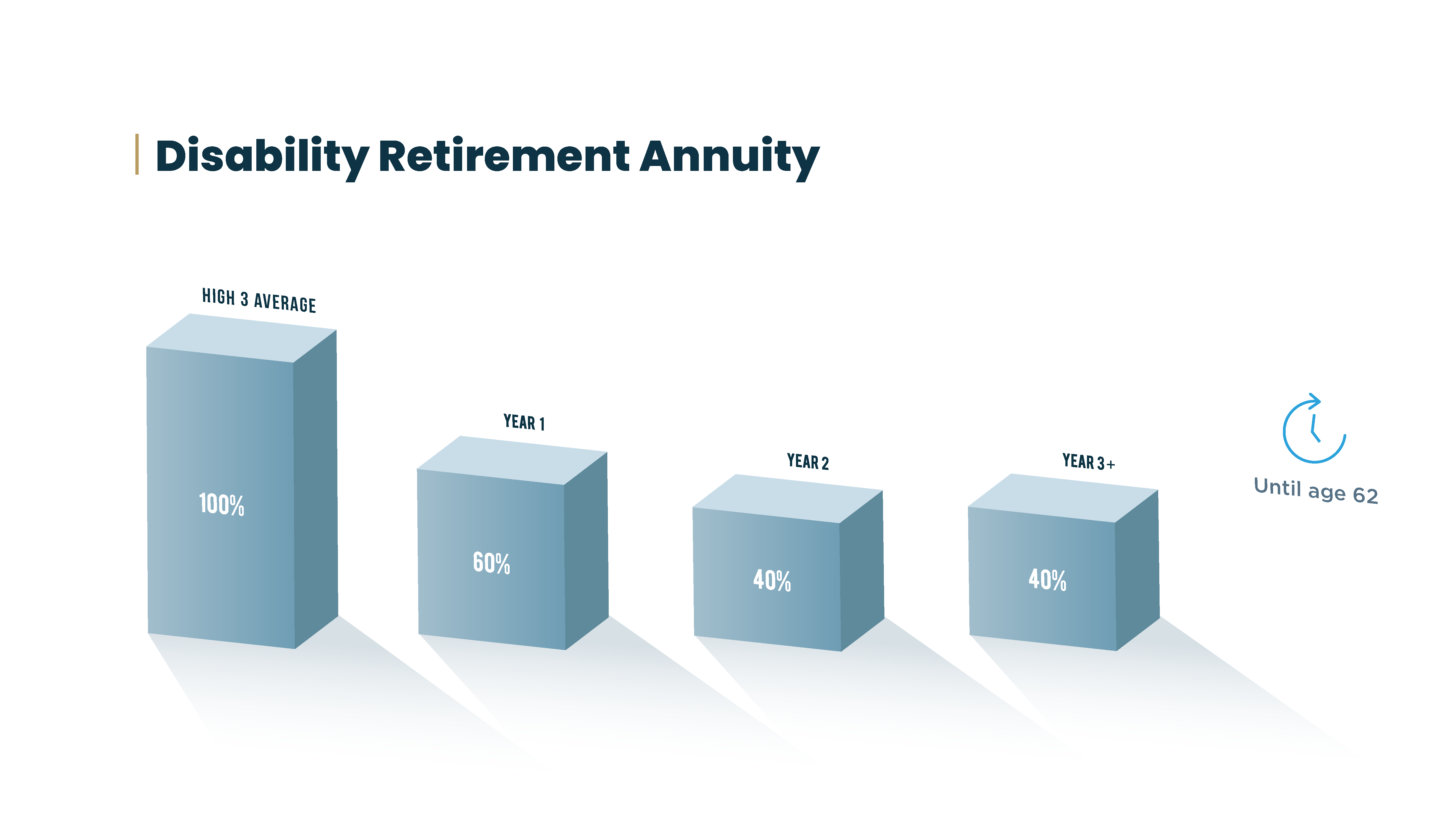
Anna: Looking at this chart, let’s say that your high three average is $100,000. That first bar represents 100% of your high three salary—$100,000. Year one on the benefit you’ll receive 60% of your high three salary or $60,000. Then year two and each year after that until 62, you’ll receive 40% of the high three salary which would be $40,000. And that’s paid monthly so it’s a monthly annuity.
Ashley: And this income is subject to federal income tax, correct?
Anna: That’s exactly right.
Working in the Private Sector While Receiving Benefits
Ashley: In addition to that 60% and 40% every following year, federal employees on Disability Retirement are able to continue working in the private sector earning up to about 80% of what their position was paying. Anna, can you give us a little bit more information on that?
Anna: Absolutely. Like you said, you can earn up to 80%—it’s of your previous position’s current salary. We do recommend that you work in the private sector and that you don’t try to get another job with the federal government because that can affect your annuity payments as well.
Ashley: Just to reiterate, it is not 80% of the high three but 80% of their previous salary, correct?
Anna: That’s right. So it’s 80% of their previous position’s current salary, which means that amount can actually go up over time.
Key Point: The 80% earning limit is based on your previous position’s current salary, not your high three average. This amount can increase over time as salary scales adjust.
Ashley: We have another chart here to break down these numbers—what it can look like when receiving Disability Retirement in addition to working in the private sector. Anna, can you go into these numbers some too?
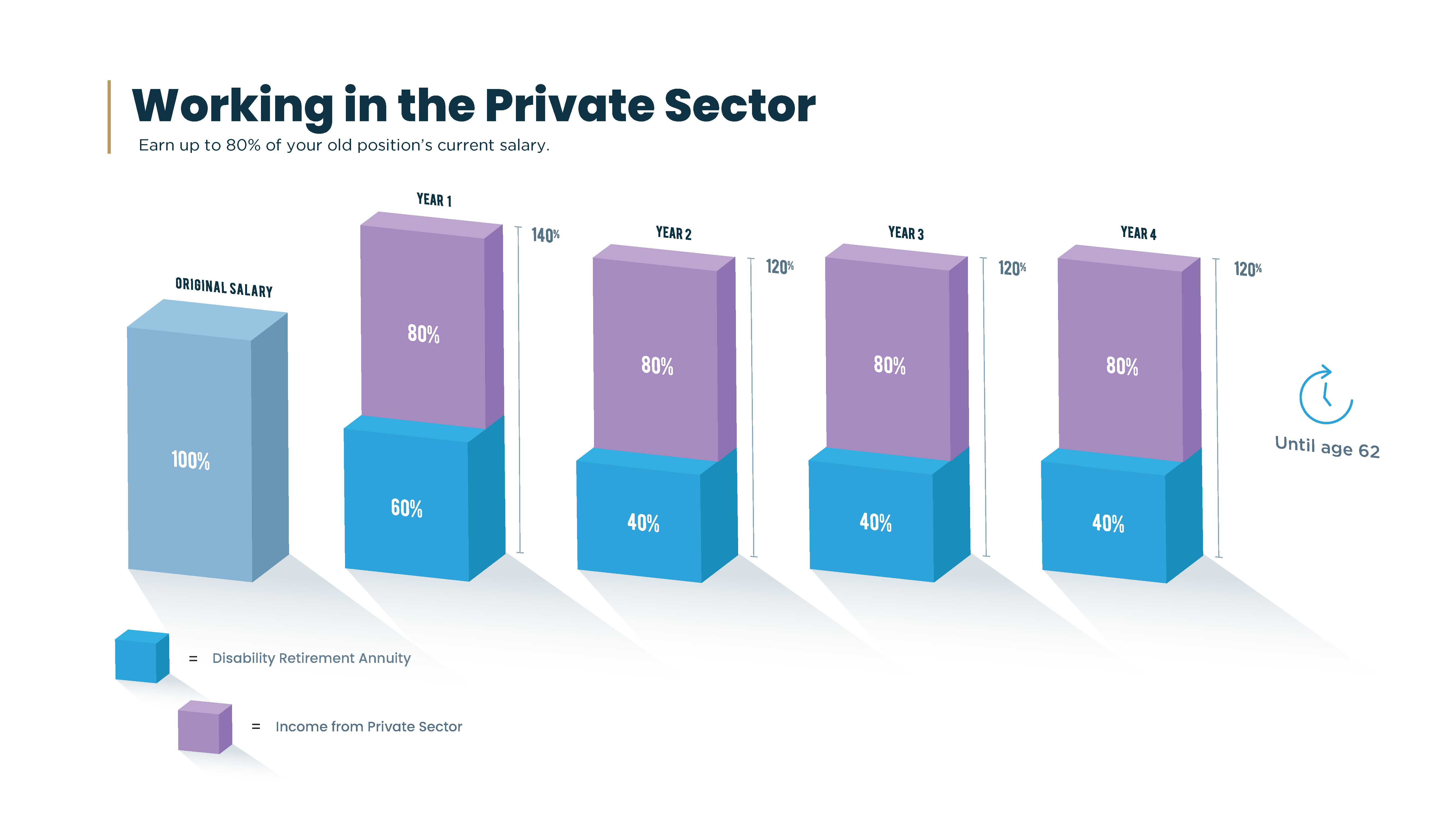
Anna: Let’s again use $100,000 as an example. If your original salary was $100,000, that’s represented by this first bar. On year one receiving Disability Retirement you’d receive the 60% of your high three salary, but then you could also work in the private sector making 80% of your previous position’s current salary for a total of 140% or using our example $140,000.
Then year two and each year after, you’d get 40% from your Disability Retirement, but then you’d also be able to continue working in the private sector making up to 80% of that previous position’s original salary for a total of 120% or $120,000.
Ashley: Something that’s really important is that these numbers on the bottom—the 60% and those 40% every year after—is a security net that is really comfortable for our clients. Those federal employees can rely on that income coming in year after year.
Anna: Exactly. So that’s secured income, and then anything you make in the private sector is just additional on top of that.
Creditable Years of Service Continue to Accrue
Ashley: Another benefit with the Federal Disability Retirement is that you do continue to accrue creditable years of service up until you reach your regular retirement age. Anna, can you talk about that a little?
Anna: Yes. So every year that you work for the federal government as a FERS [Federal Employees Retirement System] employee you receive creditable service, and then each year that you receive Disability Retirement until you turn 62 you’ll continue to accrue creditable years of service. So when you turn 62 you will receive your regular retirement as if you had worked that entire time up until age 62.
Ashley: That’s great. So for example, if a federal employee started working for the government at about age 30 and then went out on a Disability Retirement at age 40, by the time they turned 62 they would have 32 years of credible service?
Anna: Exactly. They get the full 32 years. And that’s a huge benefit of the Federal Disability Retirement where you can see that you would be able to flip over into your regular retirement with 32 years of credible service versus that 10.
Maintaining Health and Life Insurance Benefits
Ashley: The last point we’ll go over with the brief overview of a Disability Retirement is that federal employees are able to maintain their health and life insurance in retirement. If federal employees were carrying health and life insurance while on the rolls, they are eligible to carry those over into retirement.
Anna: Yep, that’s exactly right. And this is really important because a lot of our clients are really concerned about what’s going to happen to their insurance benefits and beyond that what’s going to happen to their spouse or their children’s health insurance. This is a way to maintain those benefits even in a Disability Retirement.
Occupational Disability vs. Total Disability
Ashley: We also just want to throw out one important point which is how a Disability Retirement is different from the Social Security Disability wherein this is not a total disability, it is occupational disability. Anna, can you touch on how that’s different and how that plays into Disability Retirement?
Anna: Sure. So a federal employee who’s applying for Disability Retirement only has to prove that because of their medical condition they’re unable to perform at least one of the essential duties of their position. So it’s just their federal job, not any job out there, which is why they’re able to go and work in the private sector once they’ve been approved for this benefit.
Ashley: A lot of times agencies will offer light duty assignments, different reasonable accommodations and things like that, so we’re going to jump into reasonable accommodation and how that plays into Disability Retirement.
Why This Webinar Focuses on Reasonable Accommodation
We have put together this very specific webinar about reasonable accommodation because we get these questions frequently. Agencies themselves often are unfamiliar with how reasonable accommodation plays into a Disability Retirement.
There is a definition with the ADA [Americans with Disabilities Act] and I’m going to let Anna talk about that just a little bit and how that differs from OPM’s [Office of Personnel Management] definition of a reasonable accommodation.
The ADA Definition of Reasonable Accommodation
Anna: Thanks Ashley. Most agencies understand disability and reasonable accommodations through the Americans with Disabilities Act, which requires an employer to provide reasonable accommodations to qualified individuals with disabilities who are employees or applicants for employment unless to do so would cause undue hardship. That’s a pretty general definition of what the ADA is and how accommodations work under that.
They also say that in general an accommodation is any change to the work environment or in the way things are customarily done that enables an individual with a disability to enjoy equal employment opportunities. And again, that’s pretty vague. It doesn’t have a lot of specific parameters to it.
OPM’s Definition: A Critical Difference
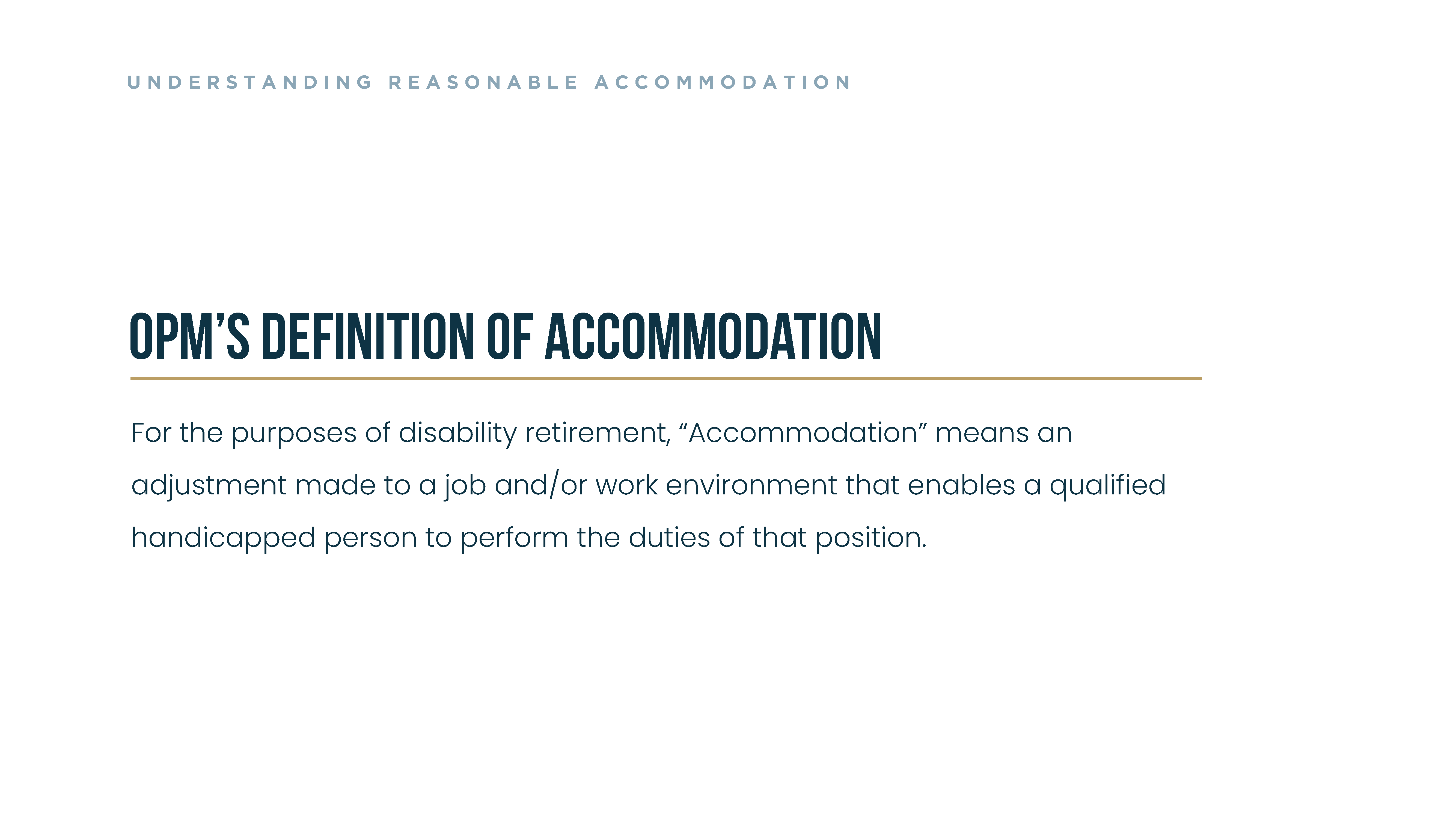
Ashley: And OPM sees reasonable accommodation a little differently, not considering light duty specifically those assignments to apply. Can you go over OPM’s definition?
Anna: Yes. So OPM considers an accommodation as far as Disability Retirement is concerned to be an adjustment made to a job or a work environment that enables the employee to continue performing all of the essential duties of their position. So this differs greatly from ADA because under ADA they consider a light or modified job as an accommodation, whereas for Disability Retirement light and modified job duties are not considered a true accommodation.
Ashley: Just to break that down a little bit, the reasonable accommodation with a Disability Retirement has to allow their employee to be able to continue performing every single one of the duties of their position.
Anna: That’s exactly right. So if you have an accommodation that takes away any of your essential duties, it is not considered an accommodation as far as Disability Retirement is concerned, which is where those light and modified duties come in. Those are not considered a reasonable accommodation for the purposes of Disability Retirement.
Ashley: Exactly, because usually a light or modified job will remove essential duties. So a good example is a letter carrier can have their position modified to they only have to be able to lift 40 pounds per their doctor’s restrictions. As far as OPM is concerned, that is not an accommodation for Disability Retirement because a letter carrier has to be able to lift 70 pounds at any given time.
Key Point: Light duty assignments that remove essential job functions do not qualify as reasonable accommodation for Federal Disability Retirement purposes, even though they may qualify under the ADA.
Reasonable Accommodation and Reassignment: A Required Process
Ashley: And this is the reasonable accommodation and reassignment—it’s a requirement of the Disability Retirement process.
Anna: That’s right. So when you are applying for Disability Retirement you have to show OPM that your agency has been unable to accommodate or reassign you into a different position.
Ashley: So we do recommend pretty early on going through the reasonable accommodation process with their agency. Can you give us some kind of information on how that process works?
When to Request Reasonable Accommodation
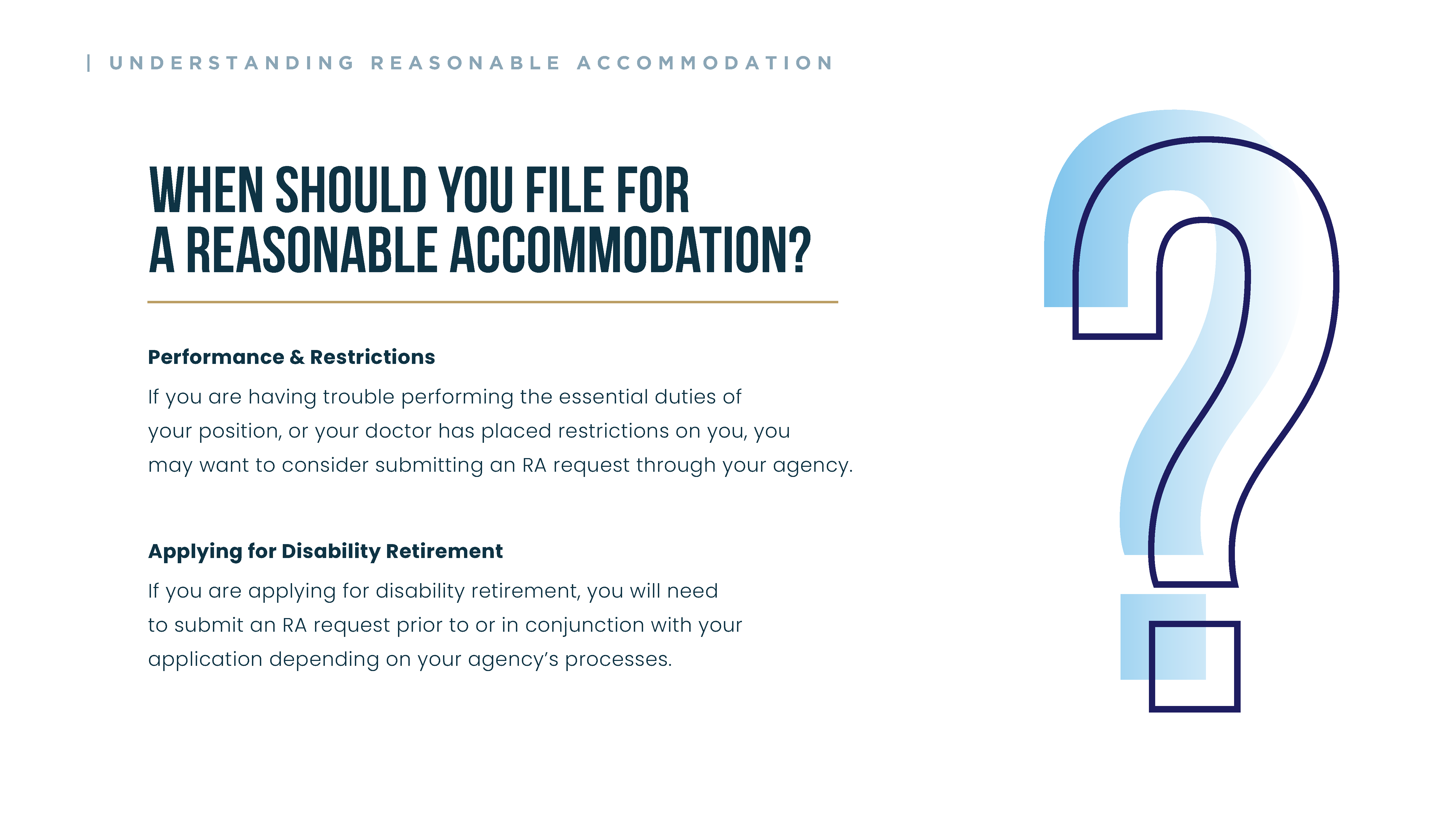
Anna: We get asked all the time, “Well, when do I need to file for a reasonable accommodation?” And the first thing to know is that if you are having issues performing your job or your doctor has placed you under restrictions, then you should be applying for a reasonable accommodation at that point along with your doctor’s restrictions.
But if you have gotten to this point and you’re ready to apply for a Disability Retirement, you’re going to have to also submit a request for a reasonable accommodation in conjunction with that application.
Ashley: And this reasonable accommodation process is something that we help each one of our clients with because there are such particular forms in the application. Anna, what do we typically help our clients with when it comes to reasonable accommodation?
Anna: So we will help our clients complete a reasonable accommodation request and will review their medical records and their personal statements to make sure that the request aligns with what they have going on and also is supportive of their Disability Retirement application.
Ashley: Yeah, and that’s a great point because the reasonable accommodation process really can make or break a Disability Retirement claim. So it is something that we are happy to help our clients with and go through this process with them.
How Agencies Process Reasonable Accommodation Requests
So we’ll kind of break down now specifically the agency process with reasonable accommodation. Anna, can you give us some information on that reasonable accommodation process with the agency?
Anna: For sure. So every agency has some standardized practices when it comes to reasonable accommodation requests and processing, but in addition to that each agency also has some pretty specific things that they do as far as their processes go—the timelines of those processes, what they might request, and even different forms from agency to agency. So we will help guide you depending on which agency you work for. We’ve worked with employees from every federal agency out there so we are familiar with each agency’s process for this.
Ashley: And specifically, what is the agency looking for? What do they typically request?
Medical Documentation Requirements
Anna: So many agencies go through what they call an interactive process, which means you submit a request but they can then request additional information. The most common pieces of information that they’re looking for are going to be medical documentation. Some agencies even have forms specifically for your doctor to complete that they’ll list out your restrictions and what type of accommodations they may recommend.
So again, if that’s the case we’ve worked with all different agencies and we can tell you when you need to get your doctor involved and even go so far as to help you understand which medical documents you should submit.
The Reassignment Process
Ashley: And when agencies kind of decide that there is no reasonable accommodation that they can provide an employee, they will start that reasonable accommodation of last resort which is the reassignment. Can you kind of go over how that factors in and how that affects a Disability Retirement?
Anna: Yep. So reassignment is another really big part of your Disability Retirement process and it’s often lumped in with a reasonable accommodation, but it is a separate requirement altogether that your agency cannot reassign you into a new position.
So a valid reassignment offer for Disability Retirement purposes must be an existing vacant position within your agency at your same pay and grade level, within your commuting area, within your medical restrictions, and which you are qualified to perform.
So if an offer of reassignment from your agency does not meet all of those criteria—every single one of them—you are not required to accept it.
Ashley: And it does have to be a position that they are qualified for and medically able to perform.
Anna: Exactly. So if there’s anything that your doctor has restricted you from that is required in this new offered position, you do not have to accept it.
Ashley: And just so everybody knows, each agency does have a different process and a different timeline when it comes to the reasonable accommodation and reassignment. So this is something where we can provide further assistance with as we’ve worked with every single one of these agencies.
Key Points to Remember
That being said, this is a lot of information and we hope we got a lot of your questions answered when it comes to reasonable accommodation. Just to kind of wrap this up, we want to touch on those major points:
Reasonable accommodation and reassignment is a requirement of the Disability Retirement application. That being said, reasonable accommodation has to allow you to perform every single one of the duties of your position, and if not it is not a valid offer of reasonable accommodation.
Following reasonable accommodation, agencies will often go through that reassignment process and this is a process we recommend you walk through as well and something that we can provide further assistance with. We are able to read through your medical records, look over that request, make sure it’s in full support of your Disability Retirement.
We hope this answered a lot of your questions on reasonable accommodation. Please do not hesitate to call our office and schedule a free consultation. We are happy to answer any questions and provide any assistance that we can.
Anna: Thank you Ashley. It’s been really great and I’m really happy we can talk about this because this is one of the topics that can have the biggest impact on a Disability Retirement application. So I really urge anybody that is concerned or has questions about this process, give our office a call and we’ll do everything we can to help you.
If you’re ready to discover your options, give us a call now for a free consultation.