
Quick Takeaways
- Your Minimum Retirement Age (MRA) depends on your birth year: It ranges from 55 to 57 and determines several of your early retirement options.
- Meeting your MRA and 30 years of service can disqualify you from Disability Retirement’s better payout: If you’re eligible for immediate retirement, your annuity is calculated at the regular rate, not the higher disability rate.
- Turning down a valid reassignment offer forfeits your right to file for Disability Retirement: Reassignment is one of the seven qualification criteria, so refusing a valid offer closes that door.
- You can still amend an MRA+10 retirement to Disability Retirement later: This can mean a higher annuity going forward plus back pay for the difference.
- Reassignment offers that look valid often aren’t: Getting a second set of eyes — like an attorney — on any offer before you sign anything can protect your case.
Common Questions
Q: What’s the difference between a regular immediate retirement and Disability Retirement?
A: Regular immediate retirement is based on meeting age and service requirements (like age 62 with 5 years, or your MRA with 30 years). Disability Retirement is for employees who can no longer perform at least one major aspect of their job due to a medical condition, regardless of age or full service credit.
Q: What are the three eligibility requirements for Disability Retirement?
A: You need 18 months of creditable civilian service, you must be a FERS [Federal Employees Retirement System] employee, and your medical condition must have arisen or worsened while in your FERS position.
Q: If I meet my MRA and 30 years of service, should I still apply for Disability Retirement?
A: You can still be approved, but your annuity will be calculated at the regular retirement rate, not the disability rate — so in most cases it won’t provide additional benefit.
Q: What happens if my agency offers me a reassignment?
A: You’re not required to accept it on the spot — you can consult an attorney first. But if it’s a valid offer and you decline it, you forfeit your right to file for Disability Retirement.
Q: If I take an MRA+10 retirement, can I later switch to Disability Retirement?
A: Yes. It can be worthwhile since Disability Retirement often pays significantly more, and you may be eligible for back pay covering the difference since your original retirement date.
Full Webinar Transcript
Understanding a Regular Immediate Retirement
Grant Ostrander (Director of Operations): When the federal government switched from the Civil Service system to FERS [Federal Employees Retirement System] back in the mid-80s, they went from a pure pension-style benefit to a three-part retirement package that includes the FERS annuity, the Thrift Savings Plan, and Social Security benefits.
Prior to FERS coming into existence, Civil Service employees didn’t get any matching funds into the Thrift Savings Plan, and they didn’t contribute to Social Security Administration benefits. It was really just a one-payer system. This lets employees diversify a bit and get a few extra benefits during their service career.
Anna Barnes (Director of Organizational Development): In order to get these benefits, you have to meet some age and service requirements as a federal employee.
Key Point: FERS has three main age and service groups for regular immediate retirement.
Grant: FERS’s most common age — the one they want you to take the most — is age 62. Most of the benefits have little extra bonuses for retiring at 62, but your service career only has to be five years long to be eligible for an immediate retirement on your 62nd birthday.
If you want to retire at age 60, you need 20 years of service, or you can retire at your MRA [Minimum Retirement Age], which is on a sliding scale currently moving up to 57 years old. If you want to retire at your minimum retirement age, your full retirement requires a 30-year career at that point.
Anna: That’s exactly right. And then they also offer an immediate retirement that is at an MRA plus 10. You have to have 10 years of creditable service at your MRA, but you don’t maintain the same amount of benefits as you would under a regular immediate retirement, and there’s also a penalty for taking an MRA plus 10.
Grant: Yeah, it can be expensive. It can still be a good option for some folks, but it’s a fairly expensive option for sure.
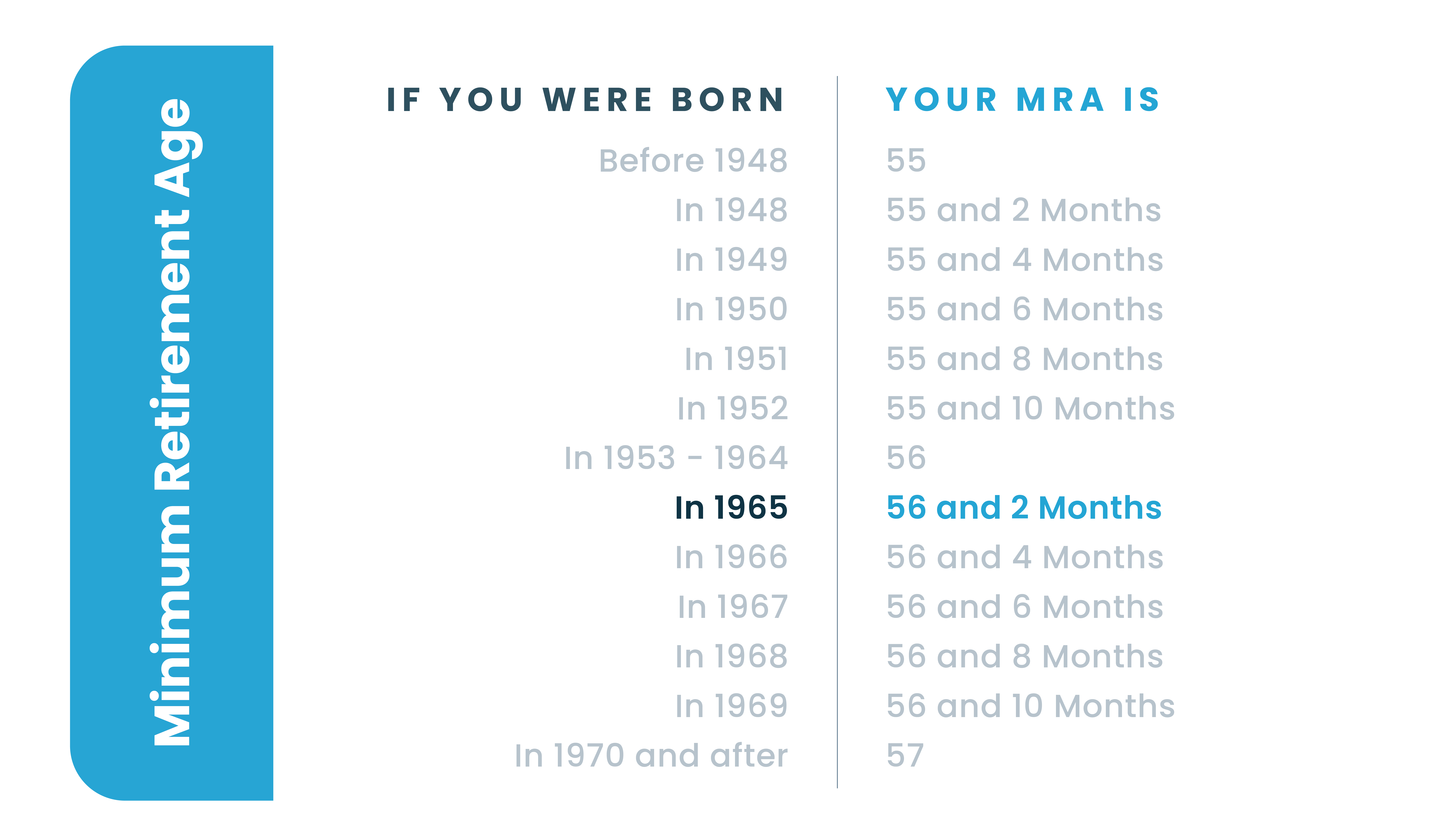
Anna: Here’s the Minimum Retirement Age chart. Your MRA is based on the year you were born. Currently, people born in 1966 and 1967 are coming up on their MRA, so you can see that’s 56 and 4 months, or 56 and six months.
Understanding Disability Retirement
Anna: Now we’re going to talk a little bit about Disability Retirement — what it is and how your MRA and years of service play into it.
Grant: Disability Retirement is for any FERS career employee who has a medical condition that’s preventing them from completing at least one major aspect of their employment. That’s a complicated way of saying: if you’ve got a medical condition that’s keeping you from doing your job all the way, Disability Retirement may be for you.
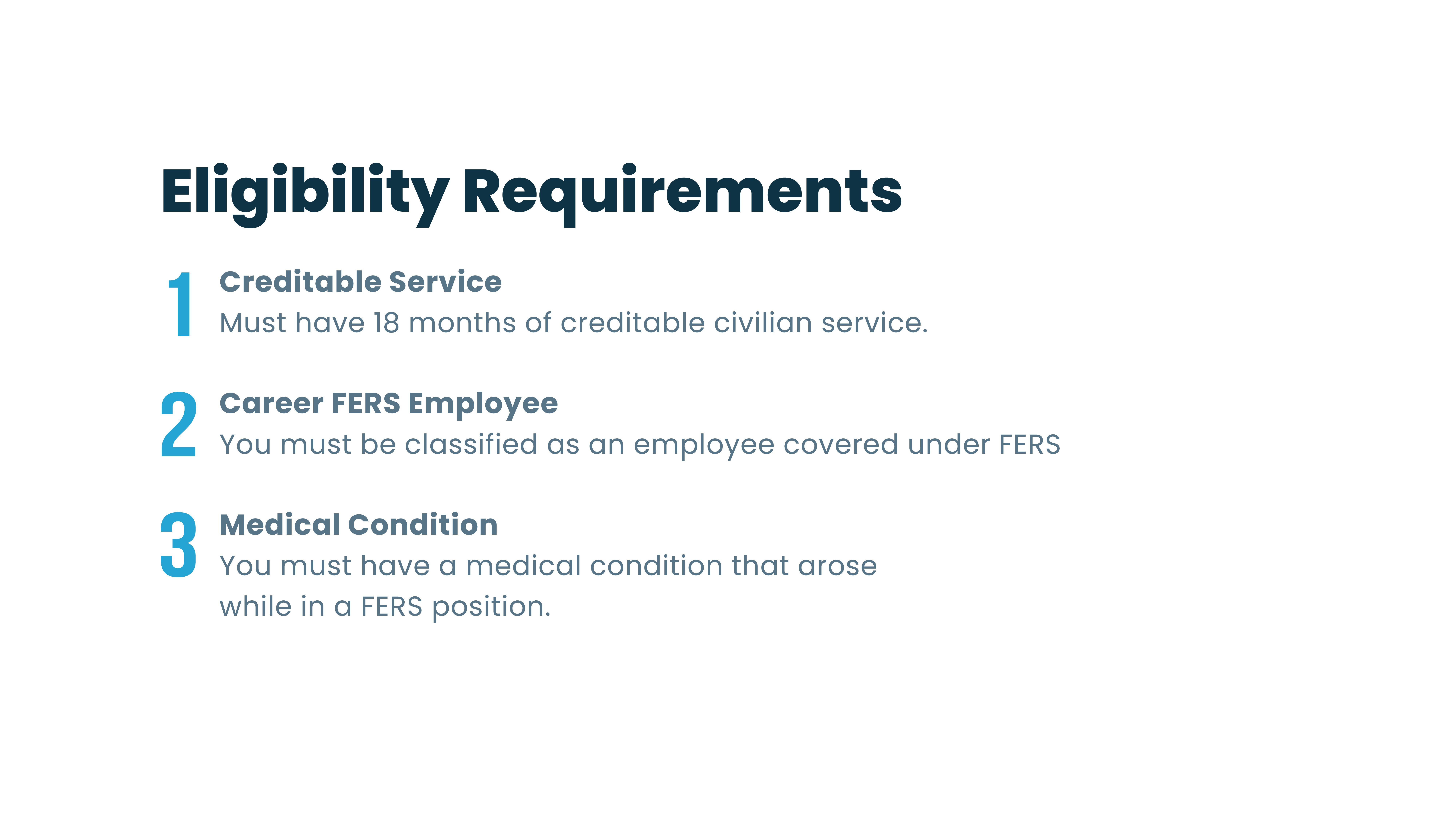
Anna: For Disability Retirement, there are a few eligibility requirements before you apply for this benefit:
-
- You need 18 months of creditable civilian service.
-
- You need to be an employee classified as FERS — you must be covered under FERS.
-
- You must have a medical condition that arose or worsened while in your FERS position.
 In addition to these eligibility requirements, there are seven qualification criteria that OPM [Office of Personnel Management] will look at when reviewing an application for Disability Retirement.
The Seven Qualification Criteria
Grant: Understanding these criteria helps you know whether or not you might be eligible to apply and be approved, but there are some nuances to them — it’s not as easy as just checking boxes. We have to prove these things and submit applications through the right channels to get them documented appropriately. I think that’s where a lot of people really struggle with it.
The important thing to know is that you have to have a medical condition that’s been diagnosed — that means you’ve sought treatment and a doctor or medical professional has confirmed it. We can’t just say “I’m hurting”; we have to say “I have a torn rotator cuff.” That’s an easy distinction to make, but one that’s hard for a lot of people to understand. If you’re having a hard time, it’s important to go see your doctor.
Key Point: The seven qualification criteria, in order:
-
- A diagnosed medical condition
- A service deficiency — some part of your job (performance, attendance, or conduct) affected by your medical condition
- That the service deficiency is caused by that medical condition
- That the medical condition and service deficiency are expected to continue for at least 12 months
- That the disability has arisen or worsened to the point you can no longer perform your position while a federal employee (it doesn’t have to be work-related in origin)
- That your agency can’t accommodate you without removing your essential duties
- That your agency can’t reassign you to a vacant position at the same grade and pay level within your commuting area
Grant: Those are the seven criteria, and there’s a lot to them. We’d love to go over those with anybody who has questions. If you’re in limbo or don’t know what to do, these are a great reference point — maybe it’s time to get a consultation with us.
Things to Consider: MRA and Disability Retirement
Anna: A few things to consider when you’re talking about minimum retirement age and Disability Retirement. The first thing I want to look at is meeting your MRA and the possibility of taking an MRA plus 10 retirement.
Some people find themselves unable to perform the duties of their job, and Disability Retirement is something they either don’t know about or that’s going to take too long to get. Some people choose to take an MRA plus 10 retirement — however, it can still be beneficial to apply for Disability Retirement after getting an MRA plus 10.
Grant: If someone needs to leave service right away and takes their MRA plus 10 but wants to go back and have that amended, it can be very worthwhile for a couple of reasons. One is that the Disability Retirement will likely be significantly higher than the MRA plus 10, and they’d be eligible for back pay between when they initially retired and took that MRA plus 10, and the difference going forward. And obviously, they’d be eligible for the higher annuity going forward too.
Anna: That’s exactly right. And then something really important to know: if you have met your minimum retirement age and 30 years of service and apply for a Disability Retirement, you can still be approved — but your annuity is going to be calculated at the regular retirement rate, the earned rate, not the disability retirement rate.
Reassignment Offers
Anna: Another really important thing to look at is reassignment offers. When you’re pursuing Disability Retirement, your agency is required to search for a reassignment that meets the reassignment offer criteria. But taking an offer — or not taking one — can impact your Disability Retirement application.
Grant: This has got about a million ways it can go, so understand we’re talking about it in the most general way possible. It’s really important that if you get offered any type of reassignment, you consult with an attorney immediately. You’re allowed to tell somebody, “Great, thanks for this offer, I’m going to consult with my attorney and get back with you tomorrow.” You’re not required to sign on the spot.
If the offer is a valid offer and it meets all the criteria, you’re not required to accept it — but if you don’t accept it, you will forfeit your right to file for Disability Retirement, because reassignment is criteria number seven out of seven. If they offer it to you and you say no thanks, it means they’ve done everything they’re required to do to take care of you, and they don’t owe you a Disability Retirement anymore.
Key Point: Reassignment offers can look valid at first glance while actually having a problem with them — something that isn’t apples-to-apples with your current job. If you accept a job that doesn’t meet the qualifications and later want to file for Disability Retirement, you’d now be filing from the new job, not the old one you couldn’t do anymore.
But you are not required to accept a reassignment that does not meet these criteria.
This is why it’s so important to get an attorney’s eyes on any offer before responding.
Anna: That’s exactly right. Offers of reassignment can often look like they’re valid, but there are a lot of nuances to what an agency will offer you, so having another set of eyes on that is always really helpful.
Example: Jacob’s Situation

Grant: Let’s take a look at Jacob, an example federal employee. Some things jump out at us: age 57, high-three average of $62,000, born in 1965, 32 years of service under FERS as a letter carrier with the United States Postal Service. He severely injured his knee while working, underwent surgery, but was never able to return to full-duty status — and the Postal Service is unable to accommodate his medical restrictions.
The area I’ll focus on is his basic details — his status and employment. He’s 57 with 32 years of service, which means he has met his MRA plus 30 requirements to be eligible for immediate retirement. That means it’s likely not the best-case scenario for him to file for Disability Retirement — he may be eligible for immediate retirement instead.
There’s an important note here: in this situation, it’s most likely the case that Disability Retirement won’t help him. But there are a number of very nuanced cases — especially if he’s on workers’ compensation benefits — where he may still need to file for Disability Retirement, and there can even be back-pay situations where that’s important. That’s a great opportunity for someone to give us a call and let us walk through that situation with them.
Anna: It really comes down to which retirement is the right one for you. There are so many different scenarios, and it’s truly an individual decision based on your circumstances. Disability Retirement can offer lots of great benefits, but if you meet your MRA and service requirements, it’s really important to know that your retirement will be paid at the regular rate, not the disability rate. That’s not to say there aren’t circumstances in which you should still pursue that Disability Retirement benefit, though.
Every Case Is Different
Grant: I first started doing this almost 20 years ago, and I’ve been involved with thousands of cases for Federal Disability Retirement here. We’ve seen so many different versions and variances that our goal is always to meet with each client and figure out where they are — in their career, their job, their medical recovery, or just their medical journey. If they’ve got something degenerative, there are so many different nuances that can make a huge difference in what your options are and what your best bets are.
That’s our number one goal whenever anyone calls us — to walk through that with each person and not just fit them into a box. It’s so nuanced. We really do want to take time with people and help them make a good decision for themselves, even if that means staying at work or using a different firm. We want people to find solutions that are most beneficial to them.
Anna: You’re absolutely right, and we take great pride in making sure we understand each individual situation, so we’re not fitting anybody into a mold. Our case managers have seen these nuanced cases and know so much about this benefit that it’s a huge help to somebody trying to navigate this decision — having someone on their side who knows the different pitfalls and possibilities along the way.
To go over what we talked about: if you are struggling to work and you have a diagnosed medical condition, Federal Disability Retirement could be the right option for you. There are eligibility requirements and qualification criteria set by OPM, but I really urge you — if you think this might be the benefit for you, give us a call. We’ll talk with you, figure out your individual situation, and determine whether this might be a possibility for you.
If you’d like to discuss your specific situation, call for a free consultation.