
Quick Takeaways
- Social Security Disability Insurance [SSDI] requires total disability: Unlike Federal Disability Retirement, SSDI only pays out if you can’t work in any capacity for at least 12 months — not just your current job.
- You can qualify for both SSDI and Federal Disability Retirement at the same time: Approval for both means a bigger combined monthly benefit than either one alone, even after the offset.
- Your Federal Disability Retirement annuity is offset by SSDI, but only for a while: It’s reduced by 100% of your SSDI payment in year one, then only 60% every year after — so your total income actually goes up starting year two.
- Applying for SSDI is a required step toward Federal Disability Retirement: OPM requires proof that you’ve applied for Social Security Disability as part of your Federal Disability Retirement case.
- Working while on SSDI caps your income at the Substantial Gainful Activity [SGA] limit: Go over it, and Social Security can determine you’re financially recovered and cut off your benefit entirely.
Common Questions
Q: What counts as a “disability” for Social Security purposes?
A: You must have a severe medical condition that prevents you from working in any capacity for at least 12 months, or that’s expected to result in death. This is a total disability standard, which is stricter than the occupational standard used for Federal Disability Retirement.
Q: How do I apply for Social Security Disability?
A: You can apply online at ssa.gov, by phone, or in person at your local Social Security office. Apply as soon as you have a diagnosed, long-term disability — processing can take three to six months.
Q: What happens if my Social Security Disability application is denied?
A: You have several appeal options: a reconsideration appeal (must be requested within 60 days), a hearing before an administrative law judge, a review by the Social Security Appeals Council, and finally a federal court review.
Q: Can I work while receiving Social Security Disability?
A: Yes, but your monthly income must stay below the Substantial Gainful Activity [SGA] limit — $1,690/month for non-blind individuals and $2,830/month for blind individuals in 2026. (Note: the recording cited older, lower figures — these are the current 2026 numbers.) Go over the limit, and Social Security may determine you’re financially recovered and end your benefits.
Q: How does Social Security Disability affect my Federal Disability Retirement annuity?
A: If you’re approved for both, Social Security becomes your primary benefit and you keep it in full. Your Federal Disability Retirement annuity is then reduced by 100% of your SSDI payment in the first year, dropping to a 60% reduction every year after — meaning your combined total income increases after year one.
Full Webinar Transcript
Understanding Social Security Disability Insurance
Caleb McKinley (Senior Disability Consultant): We’re excited today to go through this webinar together and discuss Social Security Disability for federal employees and how that impacts your benefits and what you might be able to qualify for.
Today we’ll discuss the main benefits of Social Security Disability. We’ll talk about how to apply for Social Security, whether in person or online. I’ll discuss qualifying criteria for Federal Disability Retirement [FDR] — which is a separate benefit, but has a lot of interactions with Social Security. We’ll talk about the main Disability Retirement benefits, and of course understanding the offsets between Social Security and Disability Retirement. Then we’ll wrap up with an example of a federal employee — this might match your situation — someone who’s qualifying for multiple different kinds of annuities and monthly benefits, and how they can calculate and estimate how much they stand to gain.
So, starting with the basics of Social Security Disability Insurance — Sophie, could you walk us through the basic information and who might qualify?
Sophie Rost (Learning & Development Manager): Social Security is available to all U.S. workers who have paid into Social Security. It pays benefits to people who can’t work due to a medical condition that is expected to last at least one year or result in death. In order to qualify, you must meet specific work history requirements and pay Social Security taxes on your regular earnings.
Caleb: I think it’s also important to note that the folks who qualify for this benefit are people who cannot work — and that’s considered to be a total disability. That’s one of the biggest key differences whenever we start talking about other types of disability benefits: Social Security is considered a total disability benefit. So again, you’re not going to be able to work in any capacity for at least one year, and in some cases these disabilities may result in the death of the employee.
Key Point: Social Security Disability requires total disability — meaning you can’t do any job, not just your current one. This is different from Federal Disability Retirement, which only requires that you can’t perform your specific federal position.
There are strict disability requirements, and there’s criteria for everybody. Whenever you submit your application, you must overcome this burden of proof. Sophie, what do you often see with cases of disability?
Sophie: A person must meet the definition of disability under the Social Security Act. A person is disabled under the Act if they can’t work due to a severe medical condition that has lasted or is expected to last at least one year, or result in death. That’s where we do see some overlap with our clients who are applying for Disability Retirement, because that’s a similar criteria that they have.
Caleb: That’s right. A lot of the medical conditions and disabilities we see for our clients are mental health conditions — we see a lot of folks who’ve been diagnosed with PTSD, depression, and anxiety, and severe conditions mentally that incapacitate them and prevent them from working. But of course, also the obvious physical medical conditions and disabilities — herniated or bulging discs in their back, knee injuries, traumatic head injuries, or even severe migraines. There’s a multitude of different medical disabilities that you might qualify with.
Those medical conditions must prevent any applicant from adjusting to other types of work. Again, whenever you’re speaking about eligibility for Social Security, it is a total type of disability.
Sophie: There are also other Social Security benefits, including family benefits, medical coverage, or an Achieving a Better Life Experience [ABLE] account. Can you tell us a little more about these?
Caleb: Medical coverage is included — you’ll automatically receive Medicare coverage after you’ve received disability benefits for a minimum of two years. That coverage will continue as long as you’re eligible to receive Social Security. You’ll also be eligible for an ABLE account, which offers a tax-advantaged savings account for individuals with a disability. A savings account is very beneficial for the long-term future — for yourself and for your family. It’s a great form of security, a good stable foundation, and it does help you not just in the short-term future but in the long term as well.
How to Apply for Social Security Disability
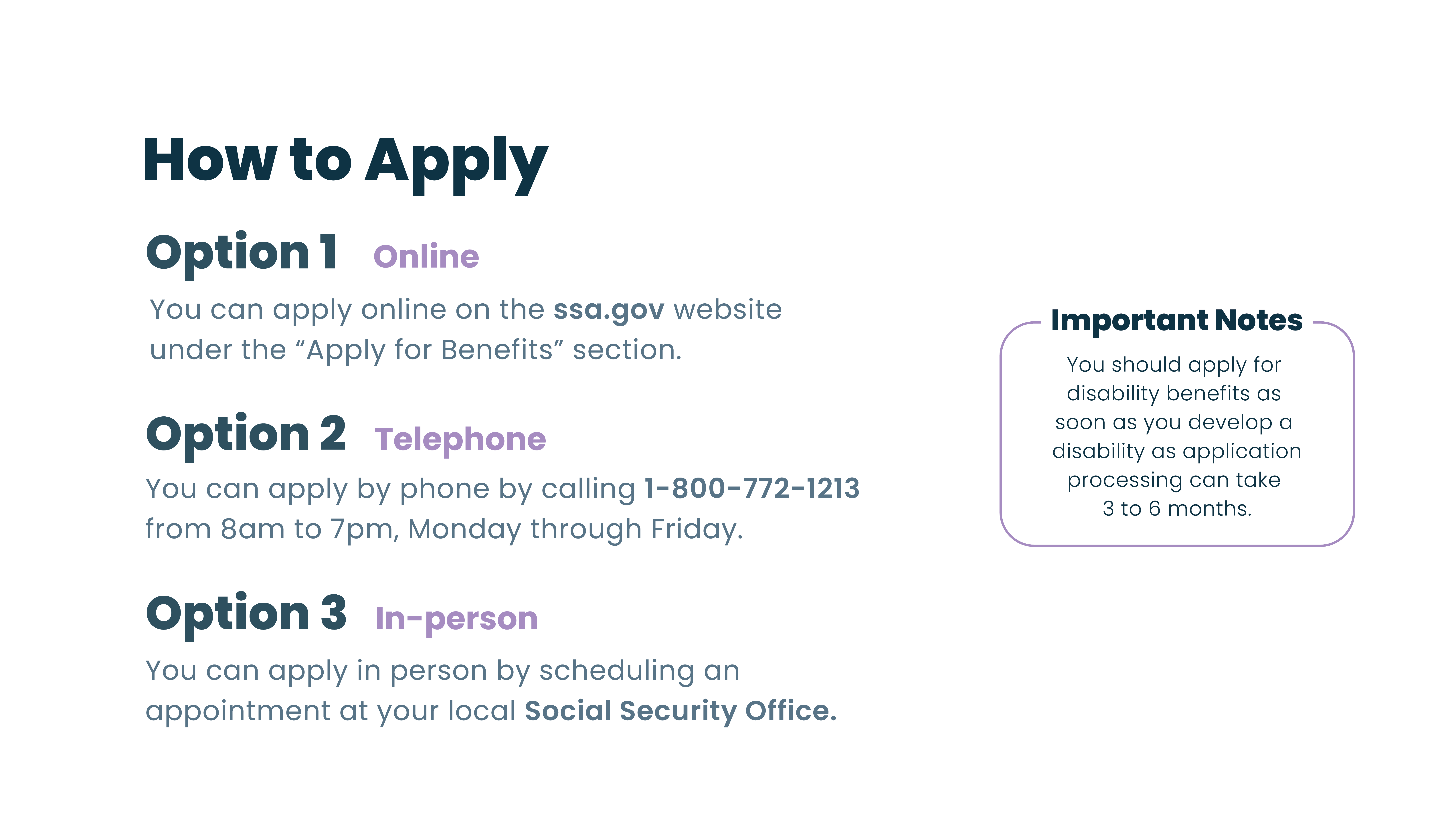
Sophie: Let’s talk about how to apply for Social Security Disability. You can apply online, over the telephone, or in person. To apply online, you can go to the ssa.gov website and look under the “apply for benefits” section. Alternatively, you can apply by phone by calling 1-800-772-1213, or call your local office to set up an appointment. Third, you can also apply in person by going to your local office and setting up an appointment.
Caleb: Regardless of which option you choose, timing is very important. You should consider applying as soon as you develop a disability, as the application process may take upwards of three to six months. If you have a diagnosed disability from a doctor and they consider it long-term, don’t wait — as soon as you know you’re eligible, take advantage of it and apply.
Sophie: Now that we’ve talked about how to apply, let’s talk about the monthly benefit payment. Caleb, can you tell us a little about that?
Caleb: Sure — this is a question I get asked a lot. For Social Security benefits, the primary insurance amount is the sum of three separate percentages of the average indexed monthly earnings. To translate that down: the amount you receive from Social Security Disability Insurance is going to vary based on your history of earnings, how much you currently earn, and how long you’ve worked. If you’ve had a career and long-term employment, there’s a lot of factors that play into calculating your earnings. It’s three separate percentages of your average indexed monthly earnings — that’s your basic calculation for Social Security Disability.
Social Security Disability Denial Options
Caleb: One of the most common responses folks receive when they apply for Social Security Disability is, of course, a denial. Whenever you are denied by Social Security, don’t panic — you have options for appealing or responding to that decision.
The obvious first step is to request a reconsideration appeal — a review of your claim, requested within 60 days of your decision notice. If you plan on requesting a reconsideration, don’t wait; don’t miss that 60-day window to reply and give them your notice of reconsideration.
Of course, there’s also a judge hearing — you can request an online hearing with an administrative law judge, where you’ll present your case and supply medical documentation and sufficient rationale to reverse the initial denial.
There are a couple of other options we sometimes see.
Sophie: You can also request a review by the Social Security Appeals Council online, or, if you’re denied by the Appeals Council, you can request a federal court review, where the federal court will take up your claim and determine if you meet the criteria.
Substantial Gainful Activity: What Does That Mean?
Sophie: To be eligible for Social Security Disability benefits, a person must be unable to engage in Substantial Gainful Activity [SGA]. Caleb, can you tell us a little more about that?
Caleb: This is a question I get asked a lot, and my basic response is: if you’re planning on working in any capacity while receiving Social Security Disability, be prepared to show that you’re making below their limit. For 2026, that limit is $1,690 a month for non-blind individuals and $2,830 a month for blind individuals.
Key Point: SGA limits are adjusted annually for cost of living, so always confirm the current figure with the Social Security Administration before making work decisions based on it.
Your monthly income must be below that limit, otherwise you’ll be deemed financially recovered, and if you’re sustainable financially, Social Security will cut off your benefits — both your monthly annuity and your medical benefits. So be mindful: if you plan to work in any capacity, you have to stay below this limit.
Sophie: Some additional Social Security Disability information — as Caleb said, receiving Social Security Disability will drastically limit your income potential and how much you can work. If you’re on workers’ compensation, there is no offset, but you can only receive up to 80% of your previous salary from both benefits combined. If you’re on VA disability, you can receive 100% of both Social Security Disability income and VA disability at the same time — there is no offset.
Federal Disability Retirement Benefit Overview
Sophie: As a federal employee, if you’re eligible for Social Security Disability, you may also be eligible for Federal Disability Retirement.
Caleb: If you’re struggling with work due to an illness or injury, Federal Disability Retirement is a benefit that allows you to retire early if you can no longer perform your work or an element of your job, and if that medical condition is also expected to persist for more than a year. There are some commonalities between Social Security Disability and Federal Disability Retirement, and you can, in fact, qualify for both.
Sophie: If you apply for and are approved for Federal Disability Retirement, you would earn a monthly annuity, continue to earn creditable years of service toward your normal retirement at 62, have the ability to work in the private sector, and be eligible to continue carrying your federal employee health and life insurance into early retirement.
Caleb: Disability Retirement annuity payments are calculated much differently from Social Security Disability payments. Your first year receiving Disability Retirement, you’ll receive 60% of your high-three average; then every year after, until you turn 62, you’ll receive 40% of your high-three. Your high-three average is calculated as the average of your highest 36 consecutive months of basic pay, which includes locality pay and your base pay.
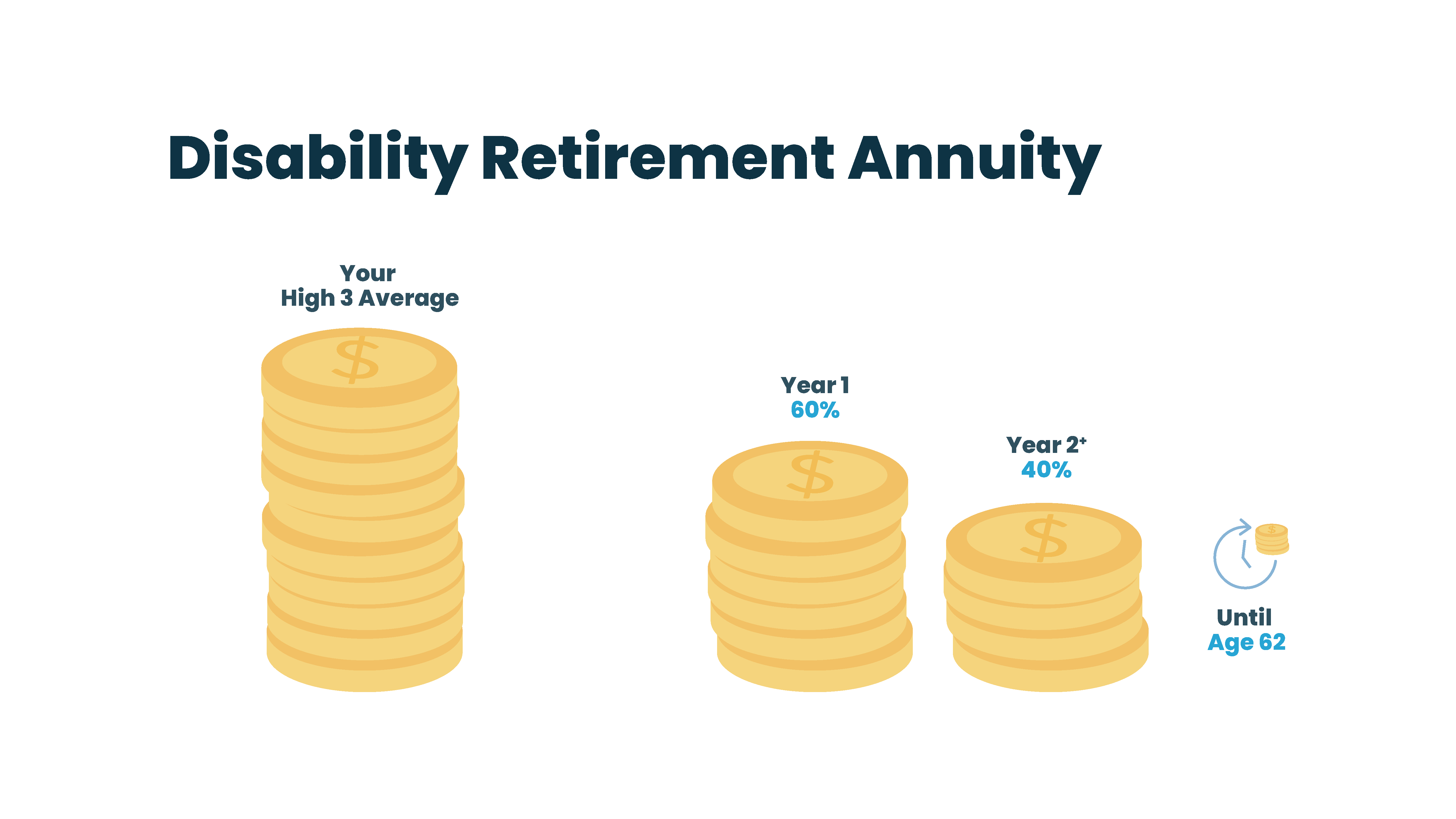
We’ve put together a visual chart that explains this. At the far left, you’ve got a stack of coins representing your high-three average — your peak earnings as a federal employee. The first year, you’ll receive 60% of that high-three; then it drops to 40%, but that’s stable income you’ll continue to receive until you turn 62. This could be 10 years, 20 years — regardless of your age at retirement, you’ll continue to lock in that 40% rate until 62. And as Sophie said, this time counts as creditable years of service toward your actual retirement, so when you turn 62, you’ll receive your full retirement as if you’d been working as a federal employee that whole time.
Let’s back up and talk about qualifying for Federal Disability Retirement. One of the biggest criteria is demonstrating a service deficiency — showing that you’re less than fully successful in the performance of your federal job. Sophie, how do we go about demonstrating this?
Sophie: This service deficiency can be demonstrated by a performance, attendance, or conduct deficiency. We can get documentation from your doctor showing that they understand you have a deficiency in performance as a result of your medical conditions, but we can also demonstrate this by getting documentation from your employing agency — a low performance appraisal, a Performance Improvement Plan, or a reprimand for something related to your medical conditions. If there’s a match between your disability and your service deficiency, that’s what OPM is looking for whenever they evaluate cases.
Understanding Federal Benefit Offsets
Caleb: Now that we’ve gone through the basics of Social Security Disability as well as Federal Disability Retirement, let’s take a look at how these two benefits interact with each other — how they offset. As we mentioned, you can qualify for both, and in fact, in order to qualify for Federal Disability Retirement, you must first apply for Social Security Disability benefits. These benefits share a lot of commonalities.
Now, if you’re approved for both, there will be an offset. An offset is simply a reduction in a benefit annuity due to receiving other benefits at the same time — in other words, they don’t want you to double-dip on your disability benefits. Not all benefits offset with each other; sometimes benefits can work together to increase your annuity payments. So there may or may not be a reduction, depending on which benefits you qualify for.
With Social Security Disability and Federal Disability Retirement, there is an offset and interaction. So how do we usually calculate that?
Sophie: If you’re approved for both Social Security Disability and Federal Disability Retirement at the same time, Social Security Disability becomes your primary benefit — you’ll continue to receive the full amount of Social Security Disability as long as you’re eligible.
If you’re approved for Federal Disability Retirement while receiving Social Security Disability, for the first year on Disability Retirement, your annuity payments from OPM will be offset by 100% of your Social Security Disability benefit. This basically means your benefit would even out — you’d receive the full Social Security benefit, plus anything additional over 100% of your SSDI benefit for that first year. After that first year, your Federal Disability Retirement annuity is reduced by 60% of your SSDI benefit instead of the full 100% reduction — meaning you’d end up getting a little more money as long as you’re eligible to continue both benefits.
A Real-World Example
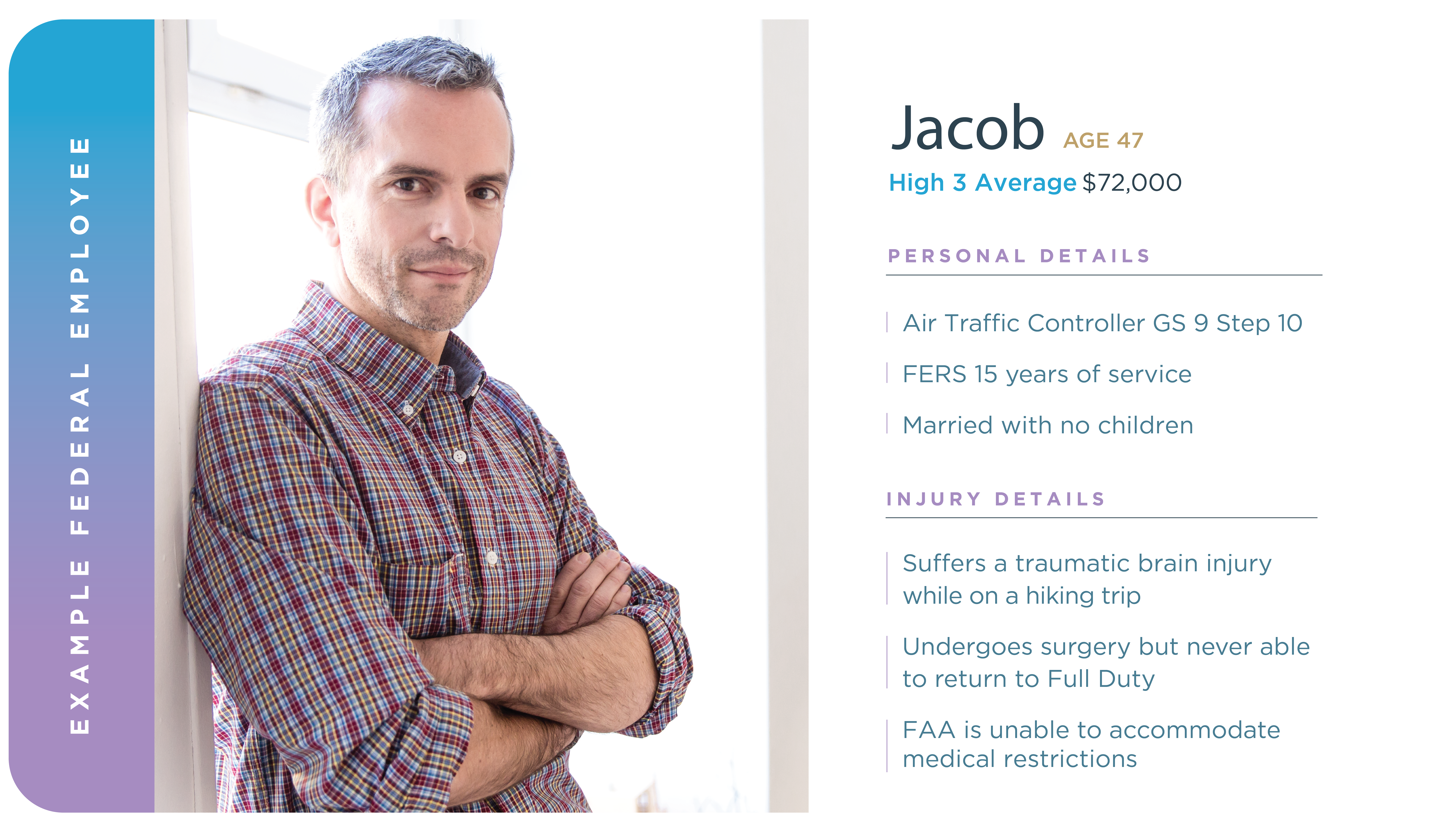
Caleb: I know at first glance a lot of this information might be confusing and overwhelming, so we’ve created an example federal employee. Jacob is a model federal employee — he’s 47 years old and his high-three average is $72,000 a year. He’s an air traffic controller, GS-9 Step 10, with 15 years of federal service. He’s married, but he and his spouse have no children.
While on a hiking trip, Jacob suffered a traumatic brain injury, and because of this, he’s unable to retain his controller clearance. He underwent surgery but couldn’t return to full duty, so the Federal Aviation Administration was unable to accommodate his medical restrictions. This story is one I see rather often — a lot of air traffic controllers, Postal Service letter carriers, and people who work for the VA or Customs and Border Protection have similar stories where their long-term disabilities prevent them from working.
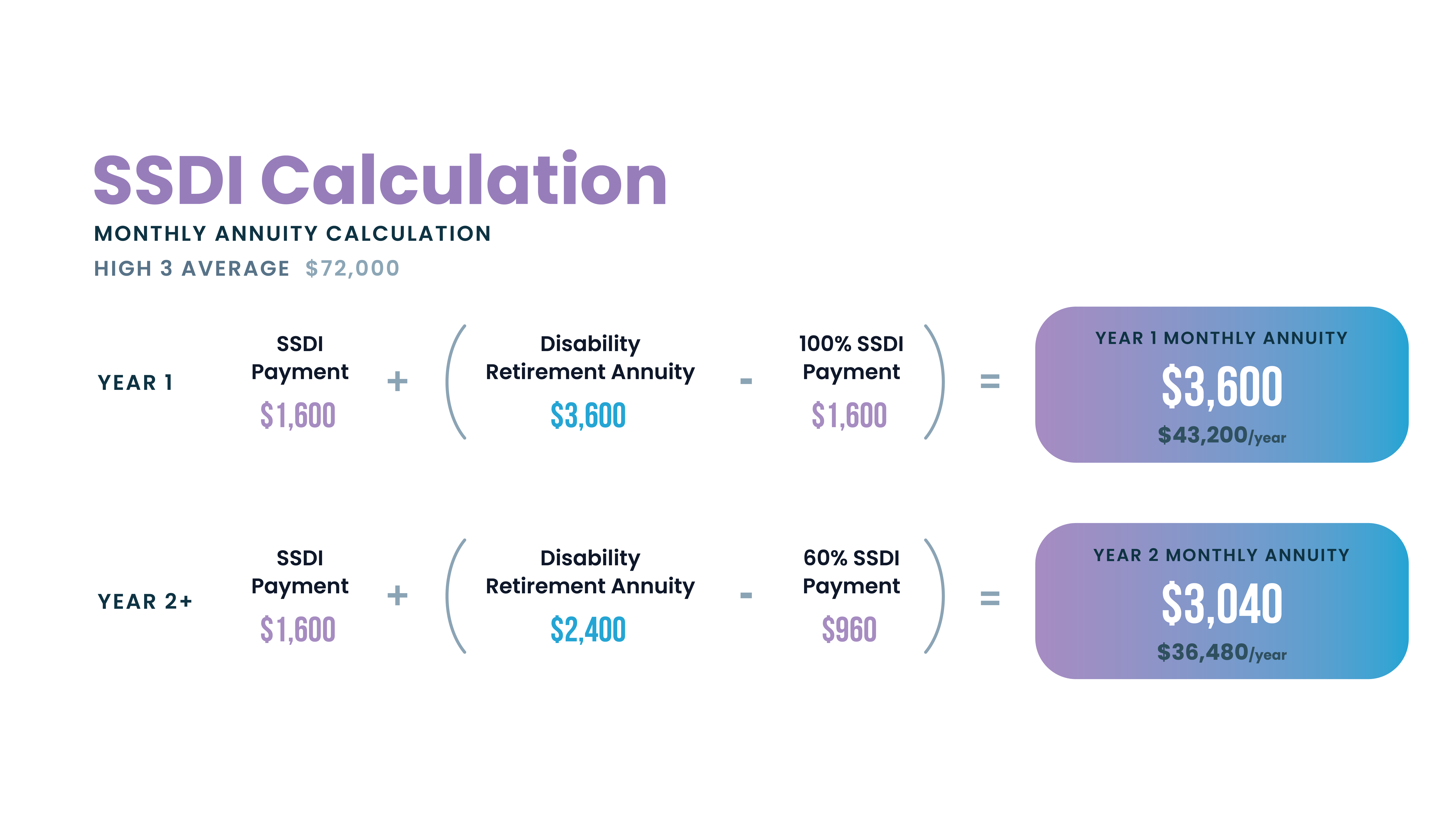
If we look at Jacob’s calculation for Social Security Disability and Disability Retirement — assuming his Social Security Disability payment is $1,600 a month, and factoring in his Federal Disability Retirement annuity of $3,600 a month (60% of his $72,000 high-three for the first year) — after factoring in the offset, his year-one monthly annuity is $3,600 a month. His sum total is more than Social Security Disability alone; it’s equal to his Federal Disability Retirement annuity, but his money is coming from multiple different disability benefits.
In year two and every year after — assuming the Social Security payment stays the same — the Disability Retirement annuity drops to $2,400, but he’s receiving a greater sum total from both benefits combined than if he were only on Disability Retirement.
These are life-changing benefits. With both Social Security and Disability Retirement approval, there’s a lot of monthly income you stand to gain — this could be life-changing financial and medical benefits that you qualify for.
Key Points Recap
Caleb: Let’s wrap up and go through our key points. Social Security Disability can provide monthly income — you can apply online at the Social Security website, by phone, or in person. If you’re denied, you still have appeal options; you have multiple options to submit your request for appeal and get approval. You could also qualify for Disability Retirement if you’re a federal employee with a career-ending injury or disability, and these benefits can interact with each other — you can qualify for both and get a greater sum total.
We have to understand, though — you can’t double-dip, so there’s going to be an offset whenever you’re receiving those disability benefits. As Sophie said, we’re here to help — that’s one of our core values as a law firm. We want to educate and inform people on what their options are and what their benefits would be.
If you want to discuss your benefits, give us a call today for a free consultation.