
Quick Takeaways
- You receive 60% in year one, then 40% annually until age 62: The first year of Federal Disability Retirement pays 60% of your high-three salary, then drops to 40% each year after until you turn 62.
- You can earn up to 80% of your former position’s current salary: While receiving Disability Retirement benefits, you’re allowed to work in the private sector and earn up to 80% of what your old federal position currently pays.
- You don’t have to be injured on the job to qualify: Unlike workers’ compensation, Federal Disability Retirement covers conditions that arose outside of work, pre-existing conditions that worsened, or injuries that happened on the job.
- It’s an occupational disability, not a total disability: You only need to prove you cannot perform your specific federal job—not that you’re unable to work any job, which differs from Social Security disability.
- You continue accruing years of service until age 62: While on Disability Retirement, you keep building creditable service years, and your benefit recalculates at 62 as if you’d worked the entire time.
Common Questions
Q: What is the high-three salary?
A: Your high-three salary is your three highest consecutive years of salary, typically your most recent 36 months. You can request a benefits estimate from your HR office to get your exact figure.
Q: Can I work while receiving Federal Disability Retirement?
A: Yes, you can work in the private sector and earn up to 80% of what your previous federal position currently pays. We recommend not working for the federal government as there can be offsets.
Q: What’s the difference between Federal Disability Retirement and Social Security disability?
A: Federal Disability Retirement is an occupational disability—you only need to prove you cannot perform your specific federal job. Social Security disability requires you to be unable to perform any substantial gainful work.
Q: What are the three types of service deficiencies OPM considers?
A: OPM considers three areas: attendance (missing work for appointments or being written out), performance (inability to perform specific job duties), and conduct (behavior issues related to your medical condition).
Q: Does my medical condition have to be caused by my job?
A: No. Your condition can arise outside of work, be pre-existing and worsen while employed, or be a repetitive injury that developed over time. It must simply prevent you from performing your current federal position and be expected to last at least 12 months.
Full Webinar Transcript
Ashley Withers (Senior Federal Disability Case Manager): We are so excited to be here today talking about qualifying disabilities for Federal Disability Retirement. This can be a confusing topic for federal employees who might not be exactly sure what can qualify them for this benefit. I’m Ashley Withers, a senior Federal Disability case manager here at Harris Federal, and I am sitting with Anna Barnes. She is the director of case processing, and no one knows more about this than Anna. So we are so pumped just to jump right in.
Anna Barnes (Director of Case Processing): Thank you so much, Ashley. I’m super happy to be here with you and happy to go ahead and explain some of these confusing things for federal employees that need a little help figuring it out.
Ashley: Exactly. And today we’re going to give kind of an overview of the Federal Disability Retirement benefit. What we’re going to cover today is understanding Disability Retirement, those qualification standards, defining disability, what that looks like, as well as the types of disabilities.
Understanding the Monthly Annuity
Ashley: So let’s start with understanding Disability Retirement. We’ll touch on these four main benefits, the first one being the monthly annuity and the breakdown of the benefit. We’ll also talk about private sector income and what that can look like on top of the monthly annuity. We’ll also go into creditable years of service, as well as touching on health and life insurance. So, Anna, we’ll start with that monthly annuity. Can you give us kind of a breakdown of that and what that looks like?
Anna: Yeah, for sure. So the first year that you’re on Disability Retirement, you’re going to receive 60% of your high-three salary. And then each year after that until you’re 62, you will receive 40% of your high-three salary.
Ashley: Right. And we get a lot of questions as to just what even that high-three is. So, can you give us just some information on what that figure is?
Anna: So, your high-three average is going to be your three highest consecutive years of salary. This is usually your most recent 36 months of salary. Not necessarily always, but that is generally the case.
Ashley: Right. And if they are not sure what that figure would look like for them, where can they find that information?
Anna: The easiest way to get your high-three salary is going to be to request a benefits estimate from your human resources office. And that will have your exact high-three salary in that estimate.
Ashley: And then we have a little figure here just to kind of give a breakdown of those numbers. So can you give us an example of what those numbers can look like? Say, if a high-three salary was about $100,000 a year?
Anna: Yeah. So that first bar there is going to represent your high-three salary—100% or $100,000. Right. For the first year, that second bar, you’ll receive 60% of your high-three salary, which would be $60,000 in this example. And then each year after that until 62, you’ll receive 40% of your high-three salary or $40,000.
Working in the Private Sector While on Disability Retirement
Ashley: And something that federal employees also may not be aware of is that you are able to continue working in the private sector while receiving your Disability Retirement benefits. This is one way that this benefit differs from Social Security disability, specifically, wherein you can work in the private sector. In addition, we do have some restrictions that we like to touch on. Can you break those down for us?
Anna: So, the first thing to remember is that you can make up to 80% of what your previous position is currently paying. And the other thing to remember is we generally recommend you do not work in the federal government. There can be offsets there. So, we do recommend you work in the private sector after retirement.
Ashley: And we have another chart here to kind of break down what that can look like when you’re receiving your Disability Retirement benefits in addition to working in the private sector. Anna, can you touch on these numbers as well?
Anna: Yeah. So that first bar there represents your original salary. And I’m going to use $100,000 again as an example. And also, keep in mind, like I said, this is the 80% of what your previous position is currently paying. So that number can actually go up over the years as your previous position salary raises.
So, if you were making $100,000 in your previous position, the first year that you’re on Disability Retirement, you’ll get that 60%. But then you’re also able to make up to 80% of $100,000, for a combined total of 140%, which in this case would be $140,000.
And then each year after that, you’ll get the 40% from your Disability Retirement, still be able to make up to 80% of your original position’s current salary, and that will come to 120% or $120,000. And you’ll notice that that 60 and 40 and 40 and 40, those keep going. So that’s secure income. And then that 80% is just additional income you can make on top of those Disability Retirement payments.
Ashley: Anna, you’re right. That’s a super helpful point because that’s secure income coming in every month. That safety net is really important to our clients.
Creditable Years of Service
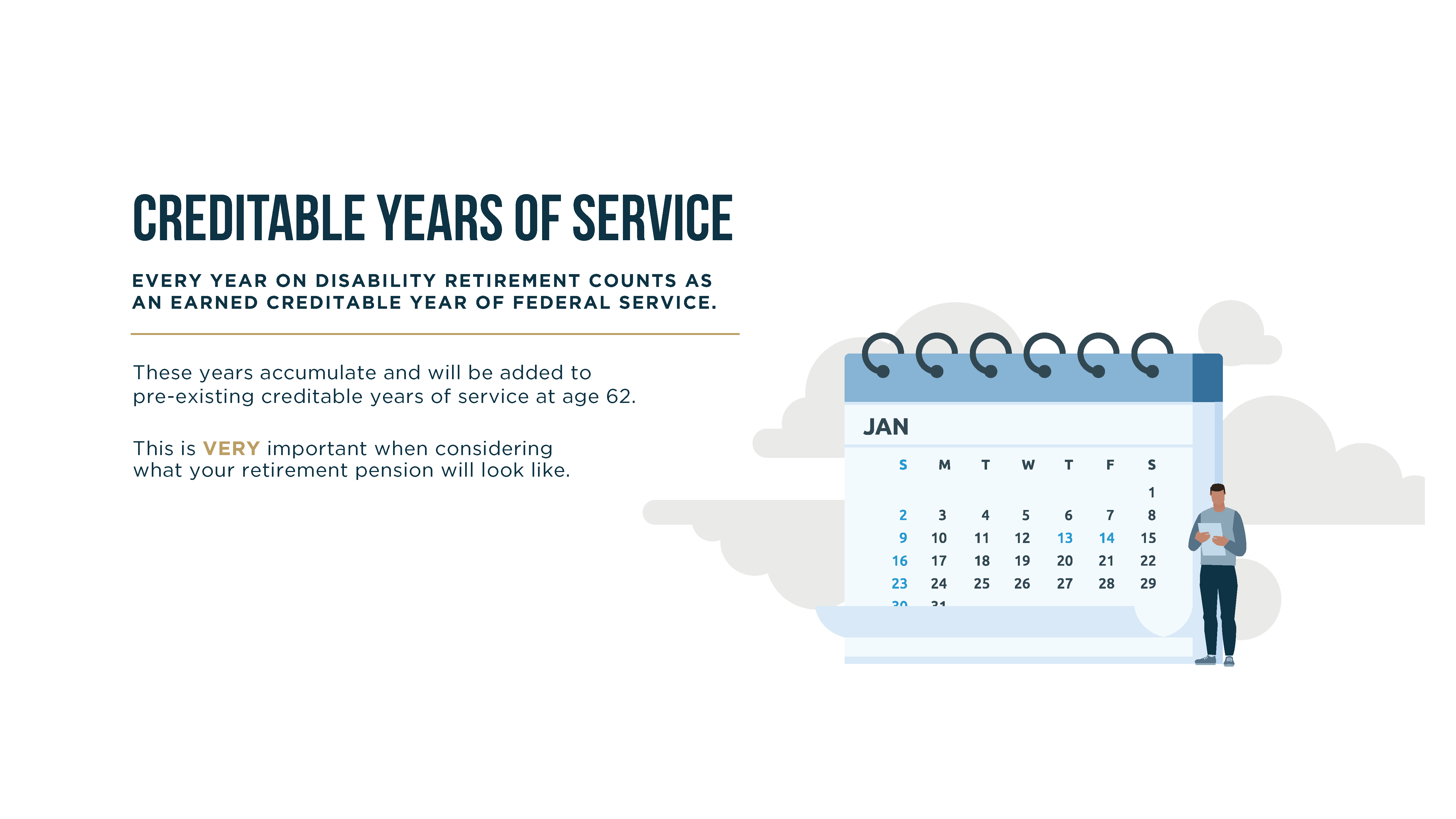
Ashley: And in addition to that, while on Disability Retirement, those federal employees will continue to accrue years of service until they turn 62. Can you touch on what that looks like?
Anna: Yeah, absolutely. So while you’re employed in the federal government under FERS [Federal Employees Retirement System], you accrue creditable service for each year that you work there. When you go out on Disability Retirement every year until you’re 62, you continue to accrue those years of creditable service.
So, when you turn 62, your Disability Retirement will recalculate and include all the years that you were on Disability Retirement as well as all of the years you worked as if you’d worked until age 62.
Ashley: Right. So, for example, say a federal employee started working in the government at age 30, and they went out on Disability Retirement at age 45. So when they turned 62, that would be 32 years of service for their regular retirement.
Anna: That’s exactly right.
Health and Life Insurance Benefits
Ashley: Perfect. And in addition to that, the health and life insurance benefits—this is something that federal employees are able to maintain on Disability Retirement. So, if you had health and life insurance while on the rolls with your agency, you are eligible to carry those over into retirement, which is a major benefit for federal employees and their families.
Basic Eligibility Requirements
Ashley: And now that we’ve gone through the points of that benefit of Federal Disability Retirement, we’re going to jump into qualifying for this benefit and go over the eligibility requirements. So, Anna, can you dive into a little bit of those requirements and who would be eligible for this benefit?
Anna: Yeah, so at the most basic level, if you are a federal employee who has a medical condition that has caused a service deficiency or impaired your ability to be useful and efficient in your current position, you could be eligible for this benefit.
Ashley: And one thing to point out as well is that this benefit is different from workers’ compensation, wherein you do not have to be injured on the job.
Anna: That’s exactly right. You could be injured outside of work, at work. It could be a pre-existing condition that has worsened since you became employed by the federal government.
Key Point: Federal Disability Retirement is an occupational disability, not a total disability. You only need to be unable to perform your specific job, not any job—unlike Social Security disability.
Defining Disability: Standard vs. OPM Definitions
Ashley: In following the who is eligible, let’s talk really briefly just about disability and let’s give a standard definition in regard to what medical conditions may qualify for Federal Disability Retirement.
Anna: So, the standard definition of disability is a physical or mental handicap, especially one that hinders or prevents a person from performing tasks of daily living, carrying out work or household responsibilities, or engaging in leisure and social activities.
And this does differ a little bit from OPM’s [Office of Personnel Management] definition. So, let’s make that contrast with what OPM considers a disability for Disability Retirement versus that standard definition.
Anna: Yeah, so OPM considers disability as far as Disability Retirement goes to be a medical condition that causes either a service deficiency or the employee to be unable to perform useful and efficient service in their current position.
Ashley: Right. And can you give us an example of what that might be?
Anna: A good example would be a letter carrier, perhaps tears a rotator cuff. Letter carriers are required to be able to lift 70 pounds at any point in their day. And they may now have permanent lifting restrictions because of that tear. And if they cannot lift 70 pounds, that’s a pretty major duty that they’re now unable to fulfill and could qualify them for Disability Retirement.
Ashley: And just to reiterate again, this injury, condition, disease does not have to be caused by their position.
Anna: You’re exactly right. That rotator cuff tear could happen on the job or at their softball tournament.
Types of Disabilities: Physical Conditions
Ashley: Now let’s kind of break down the different types of disabilities. There are physical disabilities, physical conditions, as well as mental conditions. So, these physical conditions can be traumatic injuries. They can be pre-existing, as Anna mentioned, some that have worsened while in their current position, that also lead to service deficiencies. So, Anna, can you touch a little bit on traumatic injuries?
Anna: Yeah, a traumatic injury is generally a sudden injury that is incapacitating. So this could be something like a car accident or you drop something on a body part. So that would be a traumatic injury. It’s something that happens and is immediately disabling.
Ashley: Right. That presents medical restrictions in their job.
Anna: Exactly.
Ashley: And like you mentioned before, these can be pre-existing. Can you talk a little bit about that and how it can be something that has just worsened in their position?
Anna: Sure. So, there are a few different ways that a pre-existing condition can come into play here. You may have had a traumatic injury prior to your work as a federal employee that has since had permanent implications that have worsened. And so that can qualify you for Disability Retirement.
But then an additional common type of condition that we see is repetitive work injuries that worsen over time. Again, specifically with a letter carrier who’s casing mail and carrying that 70 pounds, we see can develop things like carpal tunnel syndrome or need knee replacements. And so those types of disabilities happen over a length of time usually.
How Physical Conditions Lead to Service Deficiencies
Ashley: So, these medical conditions often cause service deficiencies, and a service deficiency does need to be present when it comes to Federal Disability Retirement. So, Anna, can you give us a little bit of information on how these physical conditions specifically can lead to service deficiencies?
Anna: Yeah, so OPM has three areas that they consider service deficiencies, and that’s attendance, performance, and conduct.
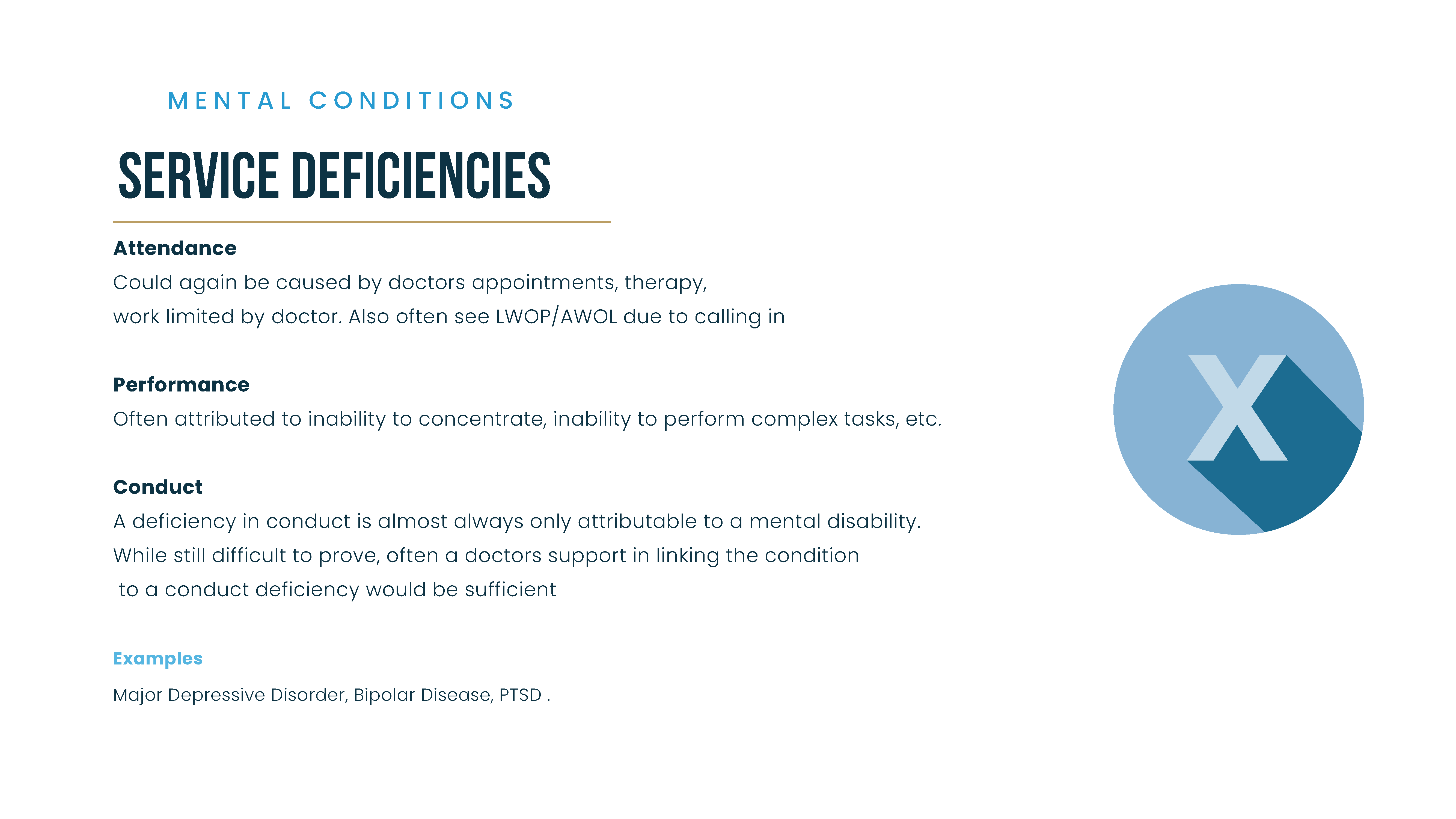
So with a physical condition, your attendance could easily suffer because you are in doctor’s appointments or physical therapy or your doctor’s written you out of work altogether. So, at that point you are no longer going to work. So that could be an attendance deficiency.
A performance deficiency is usually when you’re not able to perform a specific duty. So again, that letter carrier having to lift 70 pounds—if their doctor has restricted them from that, then they have a performance deficiency because they’re no longer able to perform that duty of their position.
The final service deficiency area is conduct, and with a physical condition, it’s actually really difficult to tie a conduct deficiency to a physical condition. And OPM does require a correlation between the two.
Types of Disabilities: Mental Conditions
Ashley: Right. And that being said, let’s go into a little bit of information on mental conditions and how those can lead to service deficiencies. So, can you give us just a brief overview on how mental conditions can lead to applying for Federal Disability Retirement?
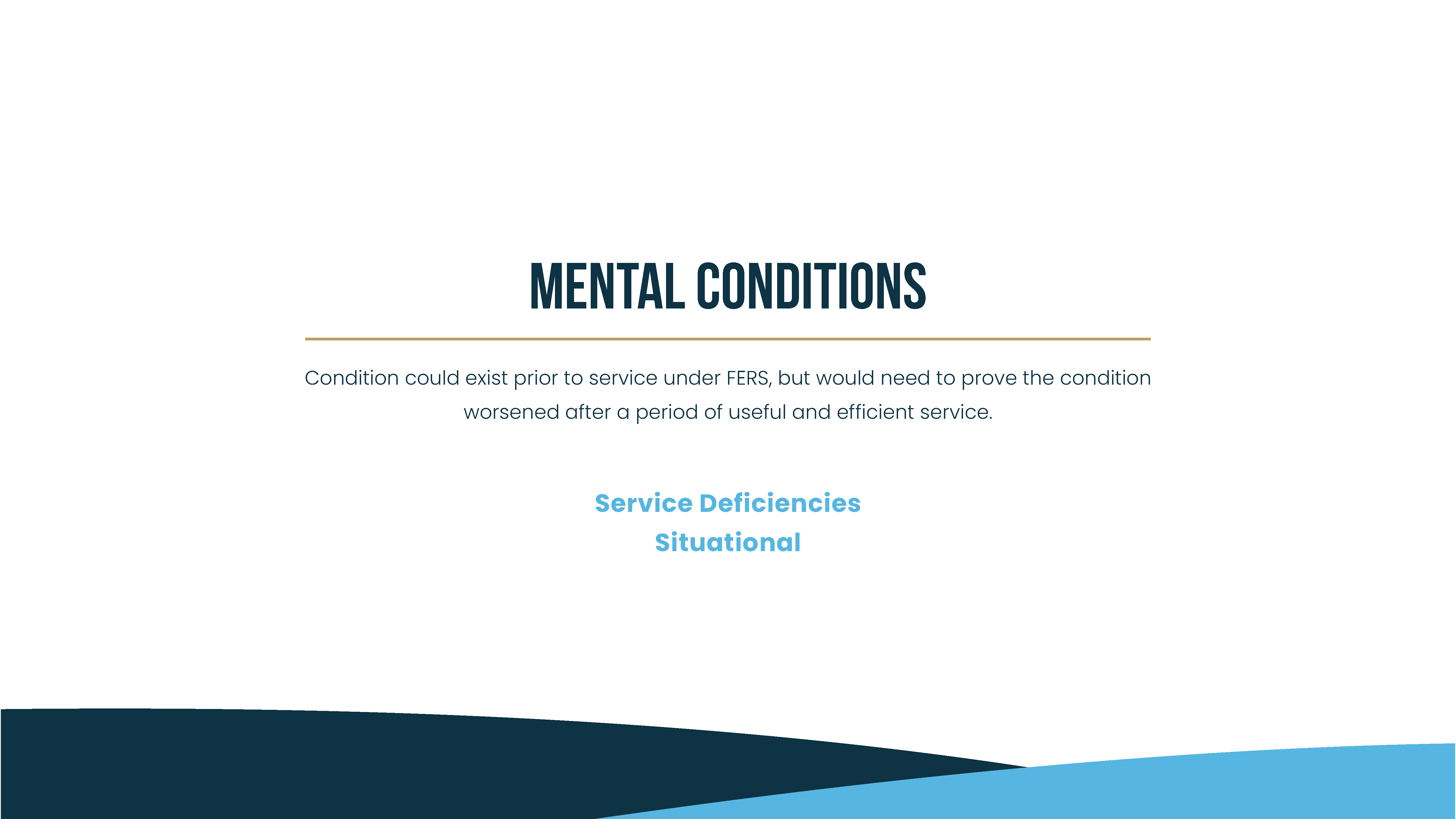
Anna: Yeah. So mental conditions, one thing I want to start with is that a mental condition could have existed and have been diagnosed prior to your employment as a federal employee, but worsened since you became a federal employee. So, it’s just like that with a physical condition. But that’s really important to note with mental conditions because they can often be lifetime conditions that you’ve dealt with, and that have since worsened.
Ashley: And can you give us kind of those definitions on how specifically mental conditions lead to service deficiencies?
Anna: Yes. So with mental conditions, the service deficiency areas are the same—attendance, performance, and conduct—but they’re affected a little bit differently.
So as far as attendance deficiencies go, again, that could be caused by doctor’s appointments, therapy, and being written out of work by a doctor. But in addition to that, you could often be put in an LWOP [Leave Without Pay] or AWOL [Absent Without Leave] status because a mental condition can hinder your ability to go to work.
As far as performance deficiencies go, mental conditions can often affect your ability to concentrate or problem-solve or perform complex tasks. So if your position description requires any of those things and you’re struggling with that because of your mental condition, that can certainly be a performance deficiency.
And then finally again, we have a conduct deficiency. A deficiency in conduct is almost always aligned with a mental disability. It’s still difficult to make that connection between the two. But a doctor supporting the fact that you’re having a conduct issue at work is related to your mental disability can go a long way to make that connection.
Ashley: And just a few examples, as you see here, for mental conditions that would qualify you for Disability Retirement would be major depressive disorder, bipolar disorder, post-traumatic stress disorder, and so on.
Understanding Situational Disability
Ashley: But we do also want to touch on situational disability and how that can be a little bit of a sticky situation, because situational disability is not something that would qualify you for Disability Retirement. So, let’s give a quick example of what a situational disability might look like.
Anna: So oftentimes when I see a situational case, it’s something along the lines of you have a supervisor who is harassing you or singling you out for some reason, and that has caused you certainly great anxiety and has even perhaps affected your work performance. But if you then have a different supervisor, you would be able to fully and efficiently perform the duties of your position.
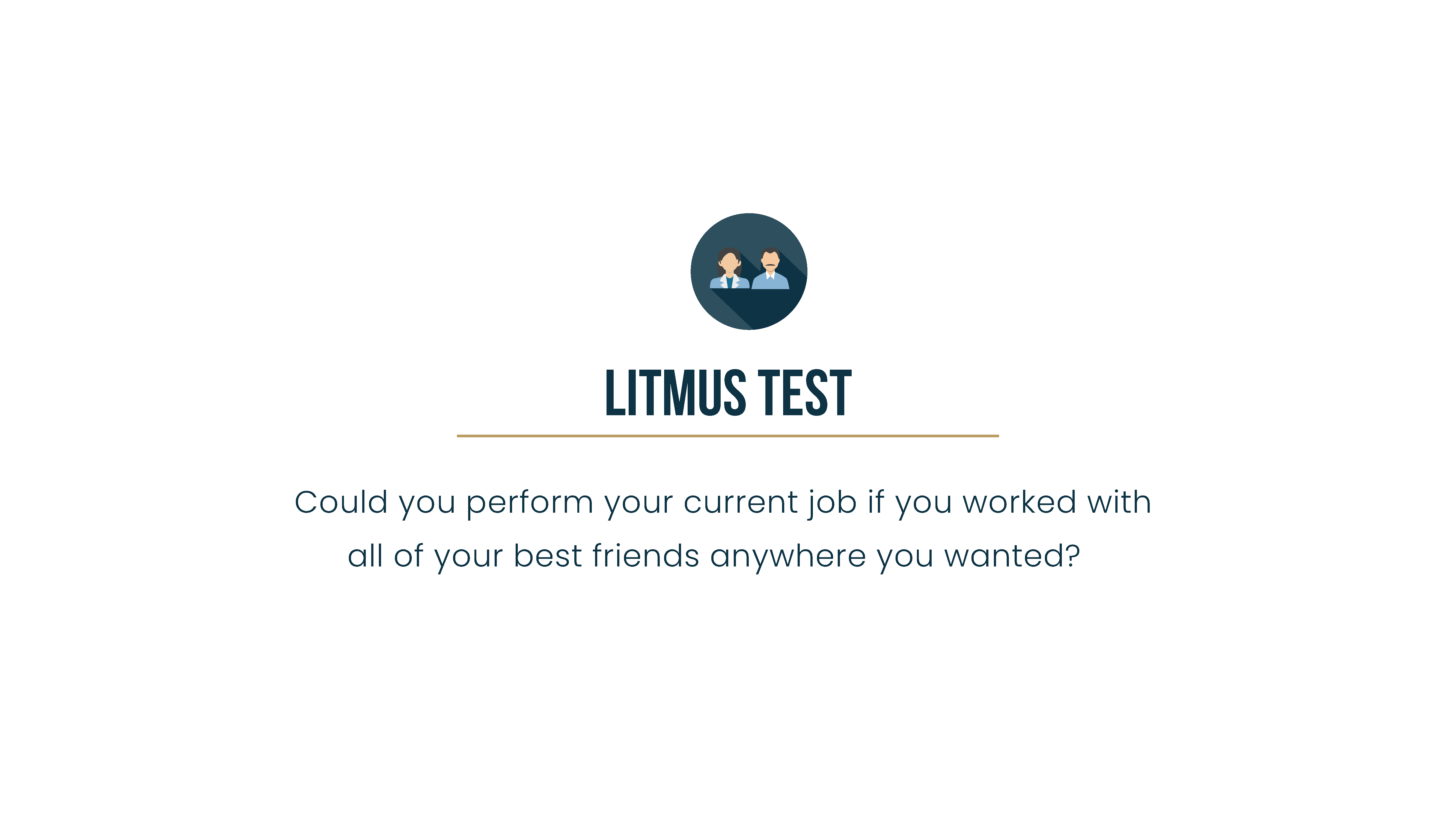
Key Point: The litmus test for a situational disability is: could you perform your current job if you worked with all of your best friends anywhere you wanted? If the answer to that is yes, then you likely have a situational situation.
Key Requirements for Qualifying
Ashley: We’ve given a lot of different examples as to what conditions may qualify you for Disability Retirement—whether it be a physical condition, mental condition, what situational disability looks like. And just remember that a medical condition does not have to be caused by your work. It could have arisen or worsened while you’ve been employed.
It does need to be backed up with medical evidence, which is where we can come in and assist with doctor statements and the support that OPM is looking for. In addition to that, it must be expected to persist for at least 12 months, which again is where your doctor comes in to make that statement. And you must just be unable to perform one or more of the duties of your position.
Anna: Thank you so much, Ashley. It’s been a lot of fun to chat with you about this, and I really just love being able to get this information out there for the federal employees that just may not know what benefits are available to them and what they might be eligible for.
If you’d like to find out about your specific situation, give our office a call for a free consultation. We’re ready to help!